What Crowdfunding Means for a Hardware Startup
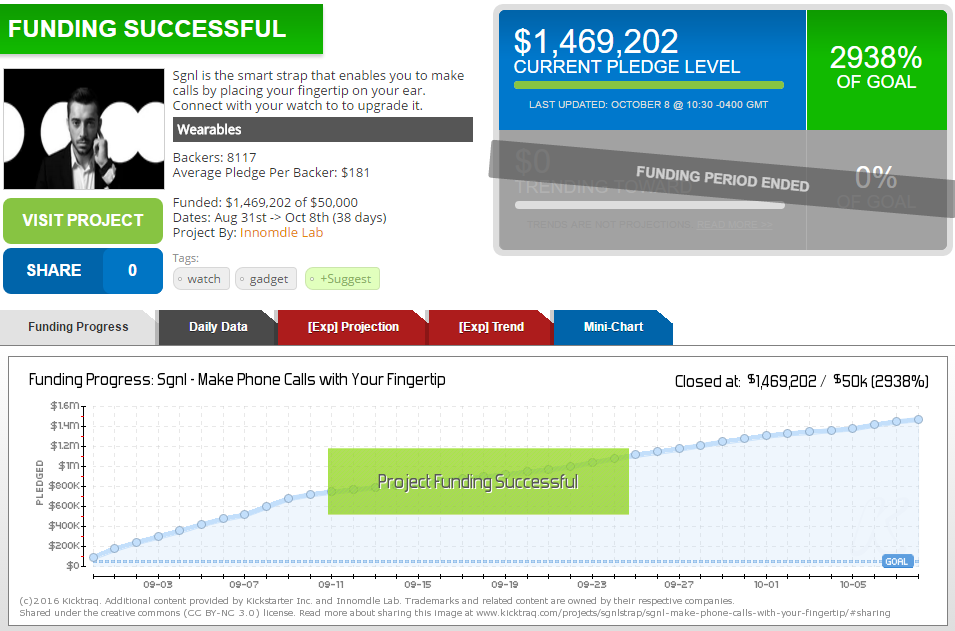
Is there a hardware startup anywhere that has not at least thought about crowdfunding? Today it is treated as a step every hardware company is simply expected to take, and there is no shortage of advice online about how to prepare. What is rare is an honest account from someone who actually ran a campaign and lived through the chaos. In this series I want to share the trial and error, and what I learned, from running the Sgnl Kickstarter campaign as the (former) head of business development at Innomdle Lab, a Samsung Electronics spin-off, and closing it at $1.47 million, in the top 0.03 percent of all Kickstarter projects.
What crowdfunding means for a hardware startup, and what it does not
What makes hardware harder than software is that big money goes out early. Nine to twelve months before launch, you are usually paying for tooling and setting up a factory line. You cannot iterate lean the way a software startup does, shoot, aim, shoot again. What made hardware dramatically easier was the arrival of what we now call crowdfunding, starting with Kickstarter. A hardware startup could pre-sell its product before launch, gauge demand ahead of time, raise the cash it needed for manufacturing, and safely produce its first batch. That changed the entire life cycle of a whole class of company. Since Kickstarter was founded in 2009, 12 million people have spent money there, and 4 million of them have opened their wallets more than once. One company’s disruptive model, built on the slightly absurd idea of paying for a product that does not exist yet, turned the live-or-die cycle of an entire category of business upside down.
For a hardware startup, crowdfunding is now simply the expected next step. Whether to do it is no longer a question. But even if you are going to do it, there is one thing a founder has to settle first: what does crowdfunding mean for your company? Why are you doing it? Only with your own answer to that can you decide when and how. Below are a few lessons, learned from experience, about how a founder should look at crowdfunding.
1. Crowdfunding is a real relationship with your first customers.
Backers are people who bought a product that has not shipped, on faith in its vision. (This varies by platform, and it is especially true of Kickstarter.) They know a startup is an experimental organization. They know the product they get for their money may have defects. They know delivery may slip. And they open their wallets anyway, because they want to cheer you on. These people are on your side. They are ready to become the most passionate fans your product and your company will ever have. They will give you product feedback, volunteer as beta testers, and, depending on how you treat them, help with whatever you ask, out of pure fandom. Think hard about what it means to have 1,000 or 10,000 die-hard fans who love your brand. The key is over-communication. Depending on how much and how well you communicate, these people become either your strongest allies or your most frightening enemies. Never let them down. Honestly, this is less a strategy than basic human decency toward people who trusted you.
2. Crowdfunding is a story.
Crowdfunding is an event. Events get covered. Goal reached. Goal reached at 200 percent. How much attention you get depends on how much genuine novelty the product brings to the market, but a first always draws eyes, and the media is ready to look kindly (barring any obvious problem) on a newborn founder’s small success. For a startup that needs to announce its existence, hitting 100, 200, or 500 percent of the goal is an occasion for storytelling: we are alive, look what we did. It is branding and buzz building. But be careful. A real brand comes from the quality of the product, not from how you look on TV. Buzz turns into hype, hype into scam, scam into hoax, in the blink of an eye. What a hardware startup ultimately has to focus on is customer satisfaction, Amazon reviews and star ratings, and NPS, not how you look in the papers. Get drunk on the coverage and you go under.
3. Crowdfunding does not prove product-market fit.
Crowdfunding only tells you there is a market. The phrase “pre-sales revenue” carries an implication founders easily overlook: the people funding you are deciding without any prior experience of the product and without a single review to check, relying entirely on expectation. In other words, it means people who share the problem your product is trying to solve are willing to pay to have it solved. It does not mean your product actually solves that problem well enough to be worth that price. Crowdfunding is the start of the game, not the end.
4. Crowdfunding is not fundraising.
Crowdfunding is pre-sales revenue, nothing more. Put differently, it is debt you repay with product. Do not be fooled by the word “funding.” Most people without experience hear it and think of investment, but strictly speaking crowdfunding is not the kind of funding you get from a VC or an angel. That is equity funding. The people putting in money do not take a stake in your company. Strictly, crowdfunding is pre-sales funding. So when someone shouts, “We raised 100 million won on Kickstarter!”, the right reading is not that they received 100 million won (roughly $85,000) in investment. It is that they pre-sold 100 million won worth of product, and now owe 100 million won worth of product, due before too long.
5. Money from crowdfunding is not development money.
This is the point I most want to stress. Crowdfunding funds production. It does not fund development. The money you earn from a campaign is for pure production costs: tooling, mass production, packaging, shipping. It is not for prototyping, and it is not for paying engineers and designers. There is a reason only 4 percent of all Kickstarter projects ship by the promised date. It is the same reason so many hardware startups that succeeded at crowdfunding end up failing to deliver and going bankrupt. Put out a product that is not ready, one still in development, and the following is inevitable: the arrangement with the factory falls apart, mass production hits problems, the design changes, the shipping plan changes, and costs you never imagined pile up. Not sometimes. Every time. Launch a campaign before you are properly prepared and it can end in disaster. And prepared means: 1) development is finished and you have at least an EP (engineering prototype); 2) you are confident the EP actually solves the customer’s problem; 3) negotiations and preparations with the factory are done, so you know your BOM (bill of materials), COGS (cost of goods sold), fixed costs, and margins fairly precisely; and 4) you are confident you can ship without delay, within the promised window, after the campaign closes.
If you are a startup thinking about crowdfunding, do not leave it at “we will do it someday.” Think these things through now, and prepare.
Original Korean version written on February 1, 2017. Translated into English with AI in October 2026.
Comments