The Cold Fortress and the Warm Table
Bom Kim’s silence, and Edward Lee’s confession
Sometimes reality is more dramatic than anything a writer could script. During the same few days that Korea was swallowing a cold anger at Coupang chairman Bom Kim’s refusal to appear before the National Assembly, and his silence, an unlikely letter arrived from the other side of the world and made us cry.
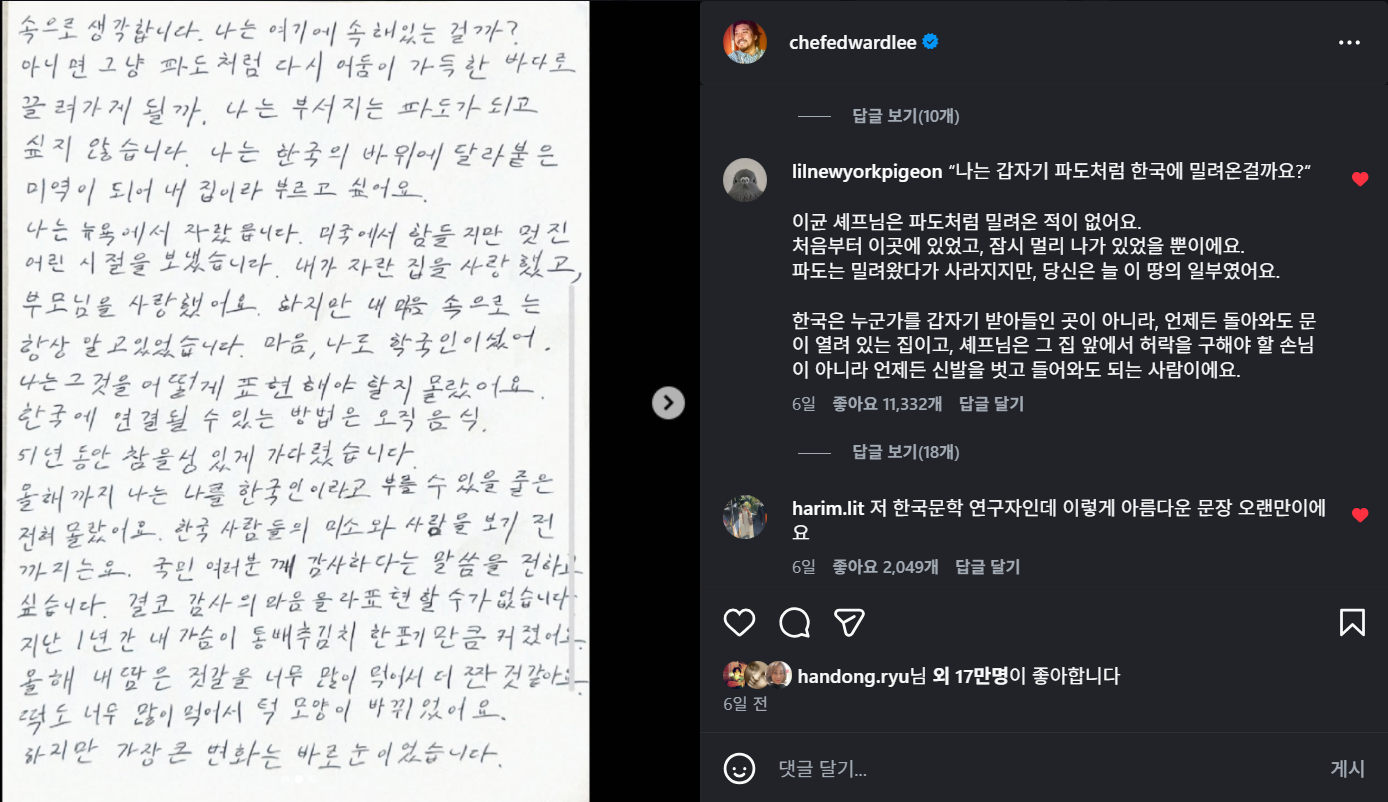
Edward Lee, of Netflix’s Culinary Class Wars, whose Korean name is Gyun Lee (이균). In a letter written in crooked, halting Korean, this master chef, who once ran the kitchen for a White House state dinner, confessed to having found his “home” after fifty-one years.
What a strange gap in timing, and in temperature. Here are two men, both successful in America, both with roots in Korea. One built a high wall toward Korea. The other knelt low before it.
The perfect stranger, the clumsy Korean
Bom Kim’s world has no gaps. His judgment is logical, his calculations exact, his responses legal. He conquered the Korean market, but he hid behind a structure carefully engineered so that he would never have to mix with the Korean community. To him, Korea is a market that generates revenue, not a home to entrust his soul to. So as not to be hurt, so as not to be blamed, he chose to remain a perfect stranger.
Edward Lee’s world, by contrast, is nothing but gaps. “I don’t speak Korean well. But even when I don’t know the words, I can feel what they mean.” He does not hide what he lacks. He fills the gaps with longing instead. “My blood is now the color of Sunchang chili powder,” he wrote (Sunchang being a county famous for its red pepper paste), and that confession burned its way into our veins hotter than any polished eloquence could.
The cold fortress, and the seaweed on the rock
This was the part that hit hardest.
While Bom Kim retreated behind the fortress of “global standards” when faced with the public duty of a National Assembly hearing, Edward Lee said this:
“I don’t want to be a wave that breaks. I want to be the seaweed clinging to Korea’s rock, and call it my home.”
Many of us fell apart in front of that sentence. An American star chef, with all that fame behind him, said he wanted to be nothing more than seaweed. Taking the rough waves full on the body, and still wanting to put down roots on this barren rock. Because it is “my home.”
This is not simple humility. This is gwiui (귀의, 歸依), the Buddhist word for taking refuge, for surrendering yourself to something larger. It is a desperate declaration of love: I will lower myself, whittle myself down, and gladly melt into the landscape of this community.
What do you long for?
What we feel toward Bom Kim is less betrayal than something closer to sorrow. Through the optimization of capital he won success, but in the end he did not win people. He can protect himself with the shield of a Delaware corporation and an American passport, but he will never know the happiness of a belonging so fierce that a man says, “On a day I haven’t tasted kimchi, I can’t sleep.”
The public is not in love with Edward Lee because he cooks well. It is because he did not call us “you people.” He called us “we.” Because he crossed fifty-one years to show us that the smell of my skin and the smell of your sweat are not so different.
A license called sincerity
At the end of his letter, Edward Lee asked himself, “Could I, someday, become one of them?”
That trembling question was really the one Chairman Bom Kim should have been asking, not Edward Lee. Gyun Lee, already “our big brother” and “our chef” in five million hearts, asked a question he never needed to ask. And Bom Kim, the one who needed to ask it down to the bone, hid behind silence.
The successful executive “Bom Kim” has everything, but he has not won the place beside us that we had to offer. The clumsy cook “Gyun Lee” set down what he had, and only then found himself seated across from us at our table.
In the end, what people want from one another is not grand innovation or results. It is one rough-hewn piece of sincerity: “I want to stand in the rain with you, and eat with you.”
One who is leaving, and one who is seeping in. What “Bom Kim,” armed with technology and capital, could never obtain is exactly what “Gyun Lee” wrote out in clumsy handwriting: a license called sincerity.
Korean society is looking at both men at once. And it is making something plain.
Who, on this land, is granted the right to belong.
Original Korean version written on December 28, 2025. Translated into English with AI in October 2026.
Comments