The Swallows Come Back to Ipgyodang
At six in the morning on July 10, 2026, I cleared one day out of a workshop on Jeju Island that was supposed to run through the 13th and headed quietly for the airport.
The morning flight landed in Daegu, and a bus took me the rest of the way back to Andong. It was a tight itinerary. I barely had time to change into a dopo (도포), the long, wide-sleeved robe Korean scholars once wore and that we still put on for rites.
At half past two, in front of Jondeoksa (존덕사), the shrine where Ryu Seong-ryong’s spirit tablet is enshrined, the goyurye (고유례) was just beginning. A goyurye is a rite of announcement: the living formally tell the honored dead what is about to happen, in this case that a lecture assembly was opening in the name of Master Seoae (서애), Ryu Seong-ryong’s pen name. Two yusa (유사), the officers who run the academy’s affairs, Ryu Si-yeok and Ryu Jong-ha, led the rite. From the courtyard outside the shrine, you could hear Ryu Yong-u, another yusa, reading the announcement aloud.
承先啓後 繼往開來
To carry forward the way of those who came before and open the path for those who follow;
to continue the lineage of learning we received and open the scholarship of the future.
When the rite was over, everyone gathered in Ipgyodang, and Ryu Si-yong, yusa, read aloud the Rules of the White Deer Grotto Academy (백록동규, the twelfth-century code Zhu Xi wrote for Confucian academies) and the village compact (향약).
Listening to those lines, I thought: this is not a reenactment of the old days. It is an attempt to pick up a lineage of learning in today’s language and open what comes next.
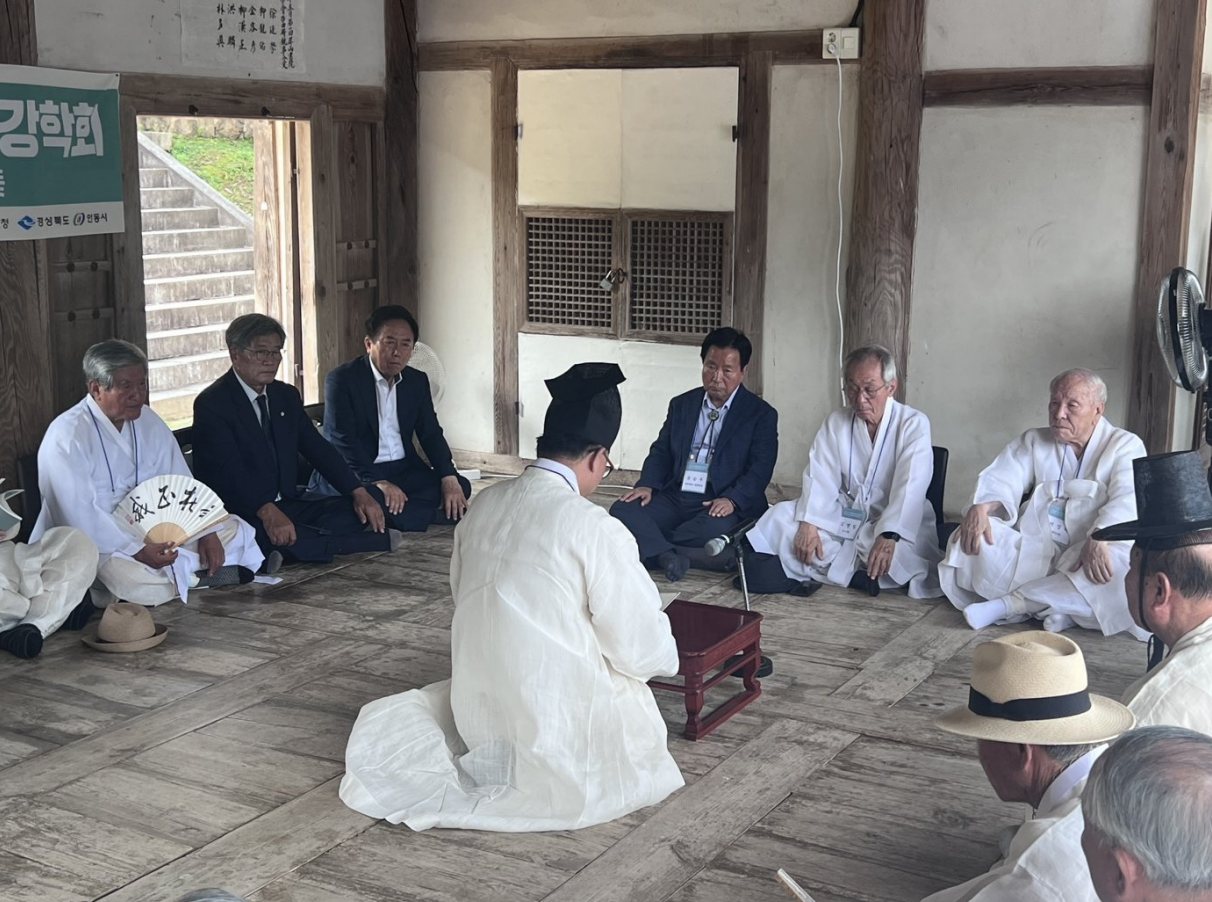
After the rite, we sat down in Ipgyodang (立敎堂).
“The hall where teaching is established.”
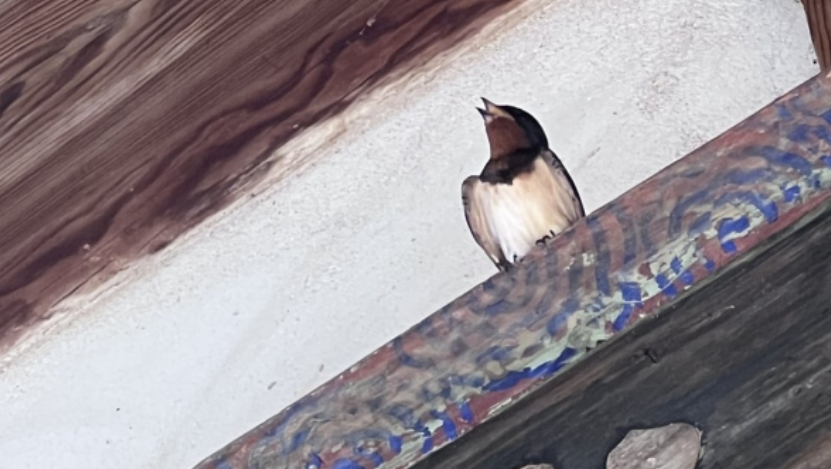
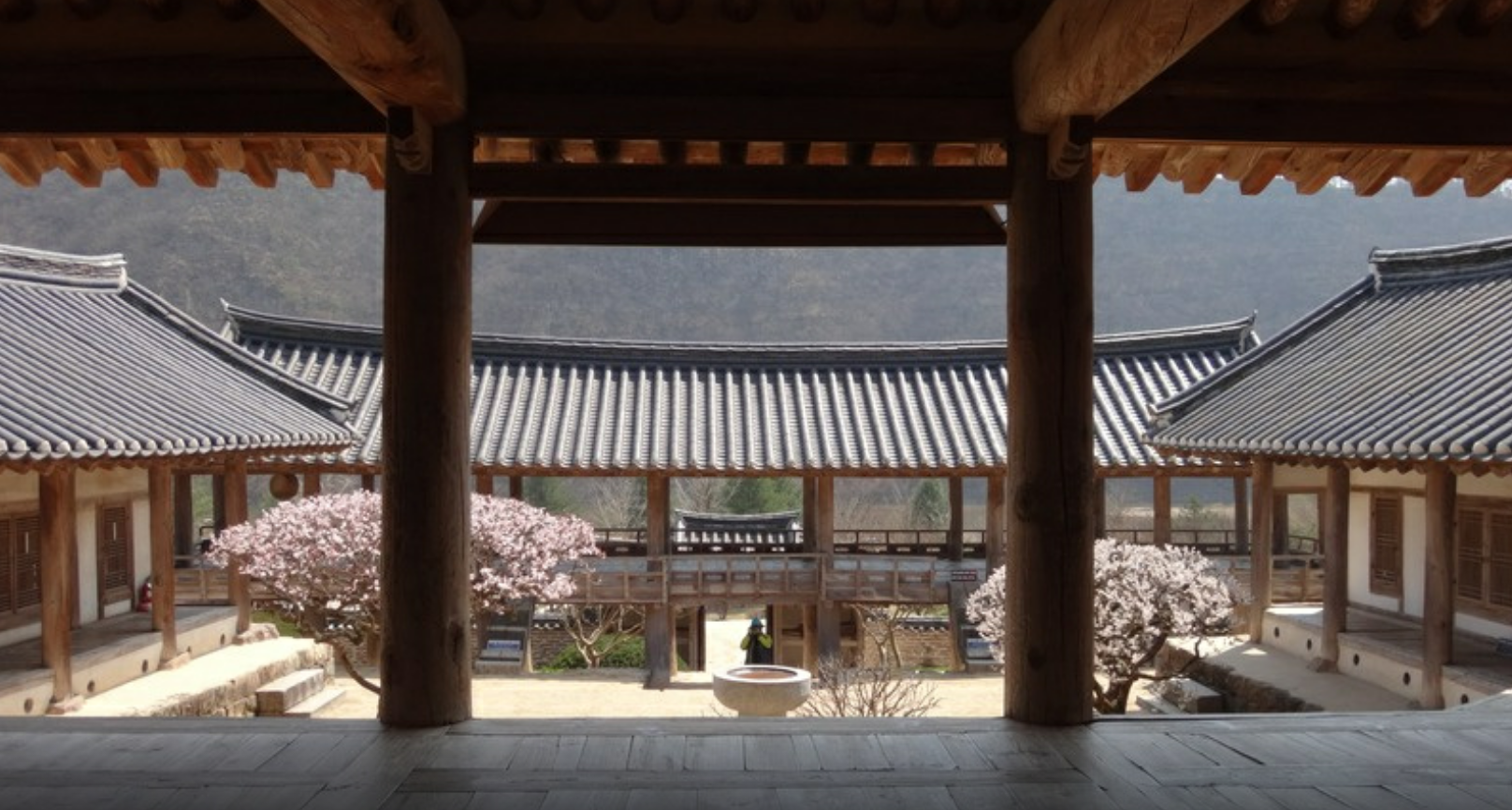
From its wooden floor, between the seven bays of the Mandaeru pavilion’s columns, the green cliff of Byeongsan and the Nakdong River spread out like a framed painting. Under the eaves, swallows flew busily in and out of their nests. I wondered: four hundred years ago, did those swallows fly over the heads of the students who read on this floor too?
To be honest, I used to feel a quiet disappointment that Byeongsan Seowon seemed to survive only as a stuffed specimen for tourists.
Something changed that. Last year, I brought a group of guests from the AI industry across Asia to Byeongsan Seowon. Chairman Ryu Han-uk, together with yusa Ryu Si-yeok and Ryu Jong-ha, showed them around, and told us that Chinese academies, which lost all memory of their roots in the Cultural Revolution, now travel to Korea, to Byeongsan Seowon and Hahoe, to learn what they themselves had forgotten.
Hearing that, I realized how remarkable it was that our elders had remembered and kept even this much of what other countries had lost entirely. I was ashamed I had not seen it sooner, and I felt I owed an apology to the elders who had kept that time alive.
On the foundation they preserved, the academy’s original purpose, gangak (강학), teaching and learning, finally seemed to be coming back to life. As time passes, I thought, everything finds its place, one thing at a time.
An academy for studying
This assembly was Byeongsan Seowon’s first step back from being “an academy to look at” to “an academy to study in.” It was described as reviving a tradition of lecture and study that had been broken for more than a century, since modernization.
The format itself was unfamiliar and refreshing.
A dokyak (독약, 讀約), the communal reading of the academy’s rules, set the discipline of learning, and a gangjang (강장, 講長), the presiding scholar, led the whole assembly. Then came lectures explaining a topic, gangdok (강독, 講讀), reading the original texts aloud and interpreting them, and gangto (강토, 講討), questioning and debating what had been read.
The schedule ran through a daytime session, an evening session, and a morning session the next day, a completely different rhythm from an academic conference where you present, collect applause, and go home. It was not one person transmitting knowledge. Everyone read the same text together, asked, answered, and asked again.
What struck me most was the manner of speech.
Han Jae-hun, who led the reading, was asked a sharp question during the discussion and answered:
“I have not examined this part carefully. If I am wrong, I would be grateful if the other teachers here would correct me.”
To say you do not know what you do not know, and to ask to be corrected together.
That one sentence showed that gangak is not a contest of knowledge but a place to learn together.
At the opening ceremony, Seo Jeong-hak, head of Byeongsan Seowon, chose the phrase ongo changsin (온고창신, 溫故創新) over the familiar ongo jisin (온고지신, “study the old to know the new”). The point was not to stop at learning the old, but to create something new on top of it.
It sounded like the best description of the atmosphere I saw that day.
Ryu Chang-hae, the primary heir (주손) of Ryu Seong-ryong’s line, described the assembly as “a place to honor the will of the sages, and to revive the academy as a living space of learning where we read together, ask, and answer.” Looking back, the assembly went exactly that way.
Precedent and memory
The first reading was the “Record of the Restoration of Worship at Jondeoksa, Byeongsan” (병산 존덕사 복향기), written by Yi Jun (李埈) in 1630. It records how Ryu Seong-ryong’s spirit tablet was moved to another academy and then returned to Jondeoksa.
The heart of the discussion turned out to be surprisingly practical:
“Can the spirit tablet of the same person be enshrined in two places in one county?”
There was debate about this at the time too, and the conclusion was that since there was precedent, it was possible.
Listening, I had a slightly different thought.
We always look for a precedent. We ask whether it has been done before. When a community is about to make a new decision, past cases become the basis of judgment and the language that persuades its members.
But every precedent had a first time.
The restoration too must once have been something someone first proposed and decided. With time, it became the precedent we cite today.
Then tradition is not only repeating forms from the past. It may be closer to a process in which a community makes new choices according to the needs of its day, and accumulates those choices in memory.
Reading the record, I thought this discussion too was ultimately about what a community decides to remember.
Beyond whether to enshrine one tablet or two,
whom will we refuse, in the end, to forget, and how?
Ritual is the form in which memory is kept, and a community makes itself by deciding what to remember.
The last passage of the record came through even more clearly read on the floor of Ipgyodang.
見屛厓之落落,想先生所樹之不拔;
觀川流之混混,悟先生道體之無息。
玆可謂善學先生。If, seeing the towering cliff of Byeongsan, you think of how what the Master established cannot be uprooted,
and, watching the ceaseless flow of the river, you realize that the Master’s Way does not cease,
then you may be said to have learned the Master well.
Sitting in Ipgyodang, this sentence stops being a metaphor and becomes the view.
The cliff and the river are the textbook.
Questions only an heir can ask
The scholars at the lectern were not the only ones who raised the density of the assembly.
Whenever the discussion ripened, questions came from the clan elders. Not about the Byeongsan Seowon of the documents, but from people who had lived their whole lives beside this place and Ryu Seong-ryong’s legacy.
Ryu Yeong-ha, who had come the long way down from Seoul, raised a doubt. In Ryu Seong-ryong’s chronology, and in the biographical accounts his disciples wrote, there is hardly any mention of Jingbirok (징비록), his memoir of the Japanese invasions of 1592. For a book we revere like a national treasure, he said, even the most basic facts, when and how it was written, have not been clearly established.
It was a question only someone who had looked long and deeply into Ryu Seong-ryong’s writings could ask.
Chairman Ryu Han-uk followed with questions about the academy’s records and traditions. What was the background when the tablet was restored? Did Mandaeru exist in Ryu Seong-ryong’s own time, or was it built by later scholars?
Ryu Chang-hae, the heir, joined the exchange with context long passed down within the clan. In his opening remarks he had brought up a story. Pungak Seodang, the study hall from which Byeongsan Seowon grew, carries a tradition that King Gongmin of Goryeo, who fled to Andong during the Red Turban invasions of the fourteenth century, was moved by the sound of students reading there. How that tradition connects to the historical record is still unknown, and he asked the scholars present to find the records and let him know.
It was a scene of the clan’s memory assigning homework to academia.
Academic research and the clan’s memory sat on the same floor and passed questions to each other.
The scholars answered from the documents. Those who had long kept the place pointed to the gaps the documents did not record. Neither side alone could complete the story.
Without the gangak format, it would have been a hard scene to witness.
Ongyeon Seodang and the low boundary
The second text that stayed with me was the “Record of Ongyeon Seodang” (옥연서당기), written by Ryu Seong-ryong himself. It records how Ongyeon Jeongsa, his study hall by the river, came to be built, and how he meant to live there.
What surprised me most was the story of a mountain monk named Tanhong (誕弘), who took it upon himself to gather alms for ten years and built the study hall for him.
A monk built a Confucian scholar’s study hall.
A scene quite different from the familiar idea that Confucianism and Buddhism had turned their backs on each other completely. The boundaries we take for granted may not be as old as we think.
In that record, Ryu Seong-ryong wrote:
人生貴適意,富貴何爲。
In life, what is precious is to live according to your own will. What are wealth and rank for?
This from a man who had entered office in middle age and spent some twenty years in the arena where fame and profit are fought over, now building a small house by the river of his hometown.
In front of it lay a deep pool, hard to reach without a boat. A visitor who got no answer had to turn back.
There he meant to read, meet friends, walk between the mountains and the valleys, and live a life that fit his own will.
And in that very place, Jingbirok was later written.
Kwon Jin-ho’s lecture on Byeongsan Seowon also stayed with me. He did not explain the academy as one beautiful building, but read it through its educational space, the rural community, the academy’s farmland, and its operating structure. When the tablet was enshrined in 1614, it was not a handful of clans but the entire Confucian community of Andong that divided up the roles of supervisor and officer and worked together. Byeongsan Seowon was, from the start, not one family’s academy but the academy of the county’s public consensus. That stayed with me.
Space too is a text.
A building becomes a shell the moment it loses what people did there.
Ipgyodang and Mandaeru survive today not only for the beauty of their architecture, but because the time of the people who read and asked questions there has accumulated along with them.
People in the heat
The first day was a heat wave from start to finish.
Inside the dopo, you were soaked in sweat within minutes. The fans kept turning, but the heat did not let up.
What amazed me more was the people.
A senior scholar who looked well past eighty stayed to the end. Researchers with no presentation of their own had traveled far just to read the original texts together. Several people from the Honam Studies department at Chonnam National University had come down only to observe.
Byeongsan Seowon is dedicated to Ryu Seong-ryong, but Ryu Sang-bung, the senior heir of Yangjindang, the head house of Ryu Seong-ryong’s elder brother Gyeomam (겸암), came too and stayed. To my eyes it looked like an older brother’s care for a younger one, and it moved me more than almost anything else that day.
This was not heat anyone could sit through because they had been told to.
As the night deepened, the questions only grew sharper.
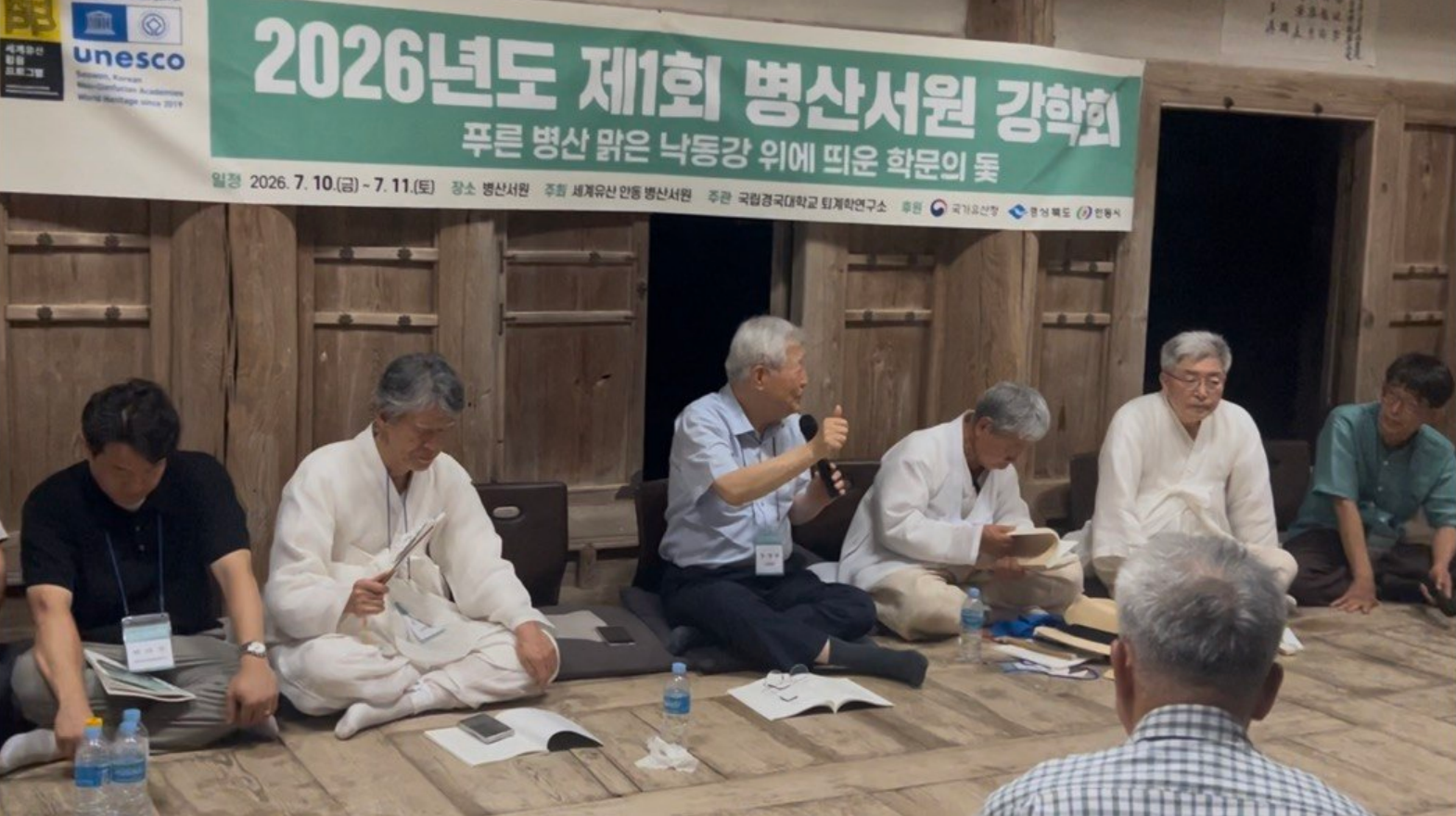
After the formal sessions came yahwa (야화, 夜話), night talk. If the daytime sessions ran on polished language, the breaks and the night brought out thoughts not yet concluded and easy, open questions.
By day, you say what the community can examine together. By night, you test thoughts not yet agreed upon. Perhaps the lecture and the night talk are not separate items on a program but two breaths of one learning. I heard the conversation after the formal evening session went on until nearly three in the morning.
I left Byeongsan Seowon between eleven and midnight.
On the way back, I thought of those who had stayed.
The rooms at Byeongsan Seowon are not large, and in midsummer they are not generous for several people sleeping together. There are no proper showers. How did they sleep?
It must have been uncomfortable.
Still, I heard they gathered again in Ipgyodang the next morning and carried on with the morning session.
I had to return to Jeju at dawn on the second day and missed it. It was the reading of the Ipgyodang ridge-beam inscription (상량문), the dedication text placed on a building’s ridge beam when it is raised, and it is the part of this trip I most regret missing.
I hope the next assembly comes before the year is out, as early as it possibly can.
Connections that flow around and back
There were personal reunions too.
Professor Kang Kyung-hyun, who sat in the same English department classrooms with me in college, was there as a discussant. It is not common to meet, on the floor of Ipgyodang, twenty-five years later, a friend you took classes with at twenty.
The way the years circled back was just like the river at Hahoe.
I also paid my respects to Kim Byung-il, head of Dosan Seowon. He turned out to be my father-in-law’s classmate at Joongang High School and an old friend.
The world is smaller than you think, and connections run farther than you think.
The assembly was not only a place to meet the old texts again. It was a place to meet old people in a new setting, and to discover threads of relationship you had not known were there.
The future is made in how we read the past
One thought circled in my head the whole way back.
What happened on that floor was not only reading old texts. It was reading today through them.
The restoration record documents where to enshrine a tablet, but to us today it read as a question of what a community will remember.
The Ongyeon record documents the building of a house, but it read as a question of how to live a life that fits your own will.
The same text asks a different question in each age, and by answering it, we make the choices of the next.
Maybe the future begins in how we interpret the past.
Rooted in the past, sending new branches toward the future.
The announcement’s ‘承先啓後 繼往開來’ had already pointed the way.
The announcement closed with this prayer:
講席恒新 絃歌弗替
May the seat of learning be forever renewed,
and may the sound of reading and debate never cease.
Byeongsan Seowon was not newly created. It was already there.
But this assembly felt like the day an academy that had long kept its place began to be called by its original name again.
Thinking about it after I got home, buildings were not the only thing that lasts.
Ryu Chang-hae, chair of the steering committee, who made this happen, and the members of the Byeongsan Seowon steering committee who worked out of sight.
Ryu Han-uk, former chairman of the Hahoe Village Preservation Society, and yusa Ryu Si-yeok and Ryu Jong-ha, who have kept the academy’s memory until now.
Ryu Sang-bung, senior heir of Yangjindang, who came the long way to be there.
Ryu Si-yong, yusa, who composed the announcement reopening the assembly and oversaw the event.
Ryu Han-jeong, who led the coordination with the Toegye Studies Institute at Gyeongkuk National University.
Ryu Yeong-ha, past eighty, who came the long way down and stayed to the end.
Hwang Man-gi, Kwon Jin-ho, and Lee Sang-ho, who gave the lectures, and the scholars who read the texts and led the discussions.
My old friend Professor Kang Kyung-hyun, met again on the same floor.
And the swallows, busy under the eaves of Ipgyodang.
If the first assembly opened the door with difficulty, what matters now is not closing it again.
Rather than waiting a full year, like swallows returning with the season, I hope people will gather on the floor of Ipgyodang again as early as they can.
With Byeongsan and the Nakdong before them, reading, asking, answering, and carrying what the day could not finish into the night.
講席恒新 絃歌弗替
May the seat of learning be ever new, and the sound of reading and debate never cease.
July 14, 2026
Jeju Island
Original Korean version written on July 18, 2026. Translated into English with AI in October 2026.
Comments