The Love That Survives Dislike
A while back I was half-listening to a lecture on YouTube when a strange thought stopped me. The speaker was predicting that Korea would one day be a leading nation, the kind other countries look to. As a Korean person, whenever I hear this sort of thing, two reactions arrive together. Two-thirds of me thinks, I really hope so. The other third says, don’t buy the hype.
Because honestly, what’s so special about us? Koreans argue all the time, non-stop. A conversation about politics can end a friendship. Online, people seem desperate to tear each other apart. We’re loud, we’re blunt, and the moment anyone sticks their head up, the first thing everyone looks for is the flaw.
And yet foreigners who come here keep saying the same thing: it’s so safe. You can walk home alone at midnight. You can leave your laptop on a café table while you go to the bathroom, and it’ll still be there when you get back. The first time I heard this I shrugged. Wait, isn’t that just normal? Why are they so amazed? But the more I thought about it, the stranger it seemed. We act like we can’t stand each other, and somehow the space we share is one of the safest anywhere.
How does that work?
My best guess is something Koreans call miun jeong(미운 정).
Jeong(정) doesn’t translate cleanly. It’s the attachment that builds up between people simply from time spent together, a sticky, unchosen kind of loyalty. Miun means hateful. So miun jeong is the bond you end up with toward someone you can’t stand. Koreans form it all the time. We complain about people and keep showing up for them. We swear we’re done with someone, and then there we are at their father’s funeral. It isn’t affection, and it isn’t forgiveness. It’s that we’ve lived alongside them so long they’ve become part of the furniture of our lives.
My parents are the textbook case. As a kid I could not make sense of them. Mom would (beep) Dad, and Dad would (beep) Mom because her (beep) was so (beep). In Mom’s account, Dad was (beep), and (beep), and had (beep) written all over him. In Dad’s, Mom’s (beep) was just (beep). Some days the tension got so tight it snapped. There was (beep). There was even (beep). And I remember thinking, with a child’s clean logic:
If they feel like that about each other, why are they still together?
Wouldn’t they be better off divorced?
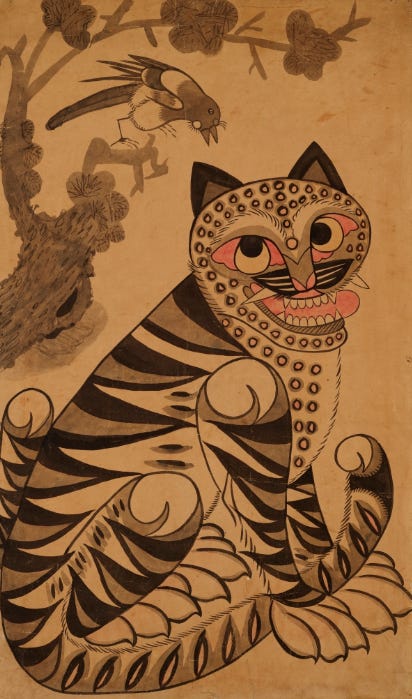
Forty-seven years later, they’re still married, and doing fine. They hardly fight anymore. Somewhere along the way Dad seems to have decided not to rise to the bait, like the tiger in old Korean folk paintings who sits there unbothered while a magpie scolds him from a branch. Their grievances didn’t shrink. They just stopped being a reason to end things.
So miun jeong isn’t exactly a lovely feeling. It’s love and resentment living in the same body, never properly sorted out, and it can wear you down. But buried in that tiresome thing is something important: a relationship that survives a bad review. You can be unhappy with someone and still not be able to bring yourself to erase them.
Maybe Koreans don’t live together peaceably because we’re especially kind. Maybe it’s because we can’t quite turn each other into total strangers.
None of this means miun jeong should keep anyone in a relationship they need to leave. Some things can’t be excused by any amount of shared history. Still, the question stands. When there’s conflict, is it the end of the relationship, or just something happening inside one?
This reminds me of a phrase I’ve wondered about for years. In Mandarin, when someone does well, you often say bucuo (不错). Literally: “not wrong,” “not bad.” But people use it to mean “pretty good,” even “great job.” Meanwhile, in California, everything is amazing and awesome all day long. To a Korean ear, the praise flows for the smallest things, for things you’d assume were simply expected. One culture keeps its compliments on a tight leash. Another hands them out like free samples. Why?
I think it comes down to what each culture assumes about existence by default.
In a society where your relationships and your place come first, you don’t need words to confirm, over and over, that you belong. Do well and people notice without saying so. Mess up and they’ll tell you to your face. Getting chewed out doesn’t get you expelled. The silence isn’t indifference. It’s that your place is taken for granted. In a society where nobody’s place is set in advance, you have to keep signaling: I see you. Praise is an evaluation, but it’s also a small act of approval that lets the other person exist for a moment, because there the default isn’t that you already have a seat. You build one from scratch.
I spent a long time learning that grammar of approval. Silicon Valley was the dream for years. I had to learn to pitch myself. Where humility isn’t a virtue, you have to say plainly what you’ve done and why it matters. Among strangers, nobody is going to read between your lines. Being able to explain clearly what you bring is a real skill.
But live inside that grammar long enough and you turn into a startup. You’re always raising. Your story has to stay compelling, your traction up to date. If you don’t show up today, you’re forgotten tomorrow. Yesterday’s applause doesn’t hold your seat. Life becomes one long pitch, one endless demo day. Everyone’s hand is in the air. Everyone tells everyone they’re amazing, and the moment the word stops, the silence feels like an empty room. When you need attention to exist, losing attention feels like losing your footing in existence itself.
Then, at some point, something shifted. Not because I got more famous or more successful than anyone. It happened as I listened to my parents’ stories, said my ancestors’ names out loud again, and traced the old relationships of Hahoe and Andong back to where I come from. Instead of inventing myself from nothing, I started finding my place inside something that was already connected. Slowly I understood that I existed before I had to explain myself.
Approval asks: were you good enough? Recognition says: I see you. Approval can be withdrawn when the terms change. Recognition accepts that you’re here before any verdict on how you did. Approval is about performance. Recognition is about existence.
We all learn recognition first in our earliest relationship. A baby isn’t born because it did a good job. It’s held because it was born. It hasn’t proven a thing, and it’s given a place anyway. When that first place is safe, a child can go out into the world, because knowing there’s somewhere to come back to after you fail is what makes adventure possible.
But a lot of people never get enough of that place. To be loved, you had to be good. To be noticed, you had to achieve. To not be left, you had to be needed. That’s when worth and existence start to fuse. When things go well, it’s proof you’re an okay person. When things go wrong, it’s proof something is wrong with you.
And pain becomes the cruelest exam. Why did this happen to me? What did I do? For most of history, people have read suffering as a judgment on their worth: divine punishment, karma, sin, incompetence, laziness. As religious ideas of cosmic justice faded, modern meritocracy picked up the thread in secular form. The successful deserved it. The ones who failed must not have tried hard enough.
So most of us push our pain onto someone else. Because what if it turns out to be my fault, and what if that fault costs me my place, and I get thrown out? Pain that puts your right to exist on trial is unbearable. And unbearable things get thrown out the window. It’s the easiest move there is. (Though what you throw tends to come back.)
But the pain you’re going through has nothing to do with your fundamental right to be here. That doesn’t mean pain has no causes. Bad choices cause pain. If you hurt someone, you owe them accountability. But no amount of accounting, however precise, decides whether a person gets to exist. Pain isn’t evidence that you’re less. Suffering doesn’t make you more, either. Pain isn’t a verdict. It’s something that happened to us, a reality asking for understanding, care, and sometimes accountability.
Healing isn’t winning back a worth you lost.
It’s realizing you never lost it.
Here’s the paradox. Someone who has grown up enough to know that their worth isn’t on the line when they suffer can actually carry more suffering. Since pain isn’t a punishment for being fundamentally unworthy, they have less reason to lie their way out of it or hand it off to someone else. Owning an ordinary mistake doesn’t make them vanish, so they can take responsibility without making excuses. Failing doesn’t cancel them, so they can look straight at their failures.
The pain each of us is rightly meant to carry, from where we stand, is what I’d call responsibility. Responsibility isn’t punishment. It isn’t the price of being a bad person.
Responsibility is the part of the reality in front of me, there because of the relationships I’ve made and the role I’ve taken on, that I shouldn’t hand to anyone else.
Pain I caused, I clean up. Pain I didn’t cause but that has landed in my life anyway, I tend to without blaming myself for it. And pain that really belongs to someone else, I shouldn’t shoulder out of guilt. By the same logic, offloading my share onto other people and calling it patience isn’t responsibility. It’s a distortion of it.
Knowing how to send back pain that isn’t yours matters as much as carrying what is. Which is why I’m wary of the idea that people who carry more suffering are somehow higher than the rest of us.
They don’t become more valuable as human beings. There’s no ranking when it comes to the right to exist.
What can grow is the capacity to hold reality. The more truth you can take in without falling apart, the more consequences you can own without pushing them onto others, the deeper you become as an ethical person.
A high position isn’t a place for more privileges. It’s the place where you’re first in line for the pain a community can’t avoid. A leader’s job is to keep the fallout of their decisions from rolling downhill onto the weakest people. Being a grown-up doesn’t mean you don’t hurt. It means you don’t take your hurt out on people weaker than you.
So, back to miun jeong. Folded inside it is a faint kind of knowledge: even if I can’t stand you, your place in me doesn’t disappear. Koreans lived by that knowledge without ever really naming it. It’s why we griped and still put dinner on the table, fought and still went to the funeral, held grudges and still couldn’t leave a sick person to fend for themselves. My parents too. They knew exactly where to dig at each other, and when one of them went down, the other was the first one there.
Miun jeong says: I may not like you, but your place doesn’t go away.
Responsibility says: and as long as your place remains, so does your share.
And suddenly I feel relieved. We made it across. Mom’s miun jeong, putting up with Dad. Dad’s, putting up with Mom. I’ll never know everything they swallowed for each other, and what’s under all those beeps, I no longer feel any need to ask. I just know that without all that putting up with, there would have been no home for me to come back to. Because two people refused, for forty-seven years, to erase each other’s place, I learned there’s somewhere to go home to even when I fail.
Tonight before I fall asleep, I’m going to think not about who I’ve put up with, but about who has put up with me. Because I’m sure I’ve been the difficult one for somebody. And there are people who say they can’t stand me, who in the end have never erased my place.
Original Korean version written on August 9, 2026.
Translated into English with AI in October 15, 2026.
**P.S.
**My mother was the first person to read this in Korean. At the dinner table she read the whole thing, and then summed up two thousand words with one bite of kimchi.
“Leave something long enough and it all gets good, doesn’t it? That’s miun jeong.
The years go by like a dream. It hurt when your father got angry and slammed the door, sure. But I couldn’t tell you when that even was. He did it a few times. That’s about it.”
She was talking about kimchi, which only gets better the longer it ferments. And about forty-seven years of marriage, the ones I couldn’t bring myself to write down and bleeped out of the essay. The person who actually lived them had already filed them away like that.
Comments