Bomb, Tomb, Womb: What Will the Scientists' Village Give Birth To?
Los Alamos gave birth to the bomb, and the bomb left tombs. For centuries, Hahoe has turned tombs into a womb. What will Andong's new village of scientists give birth to?
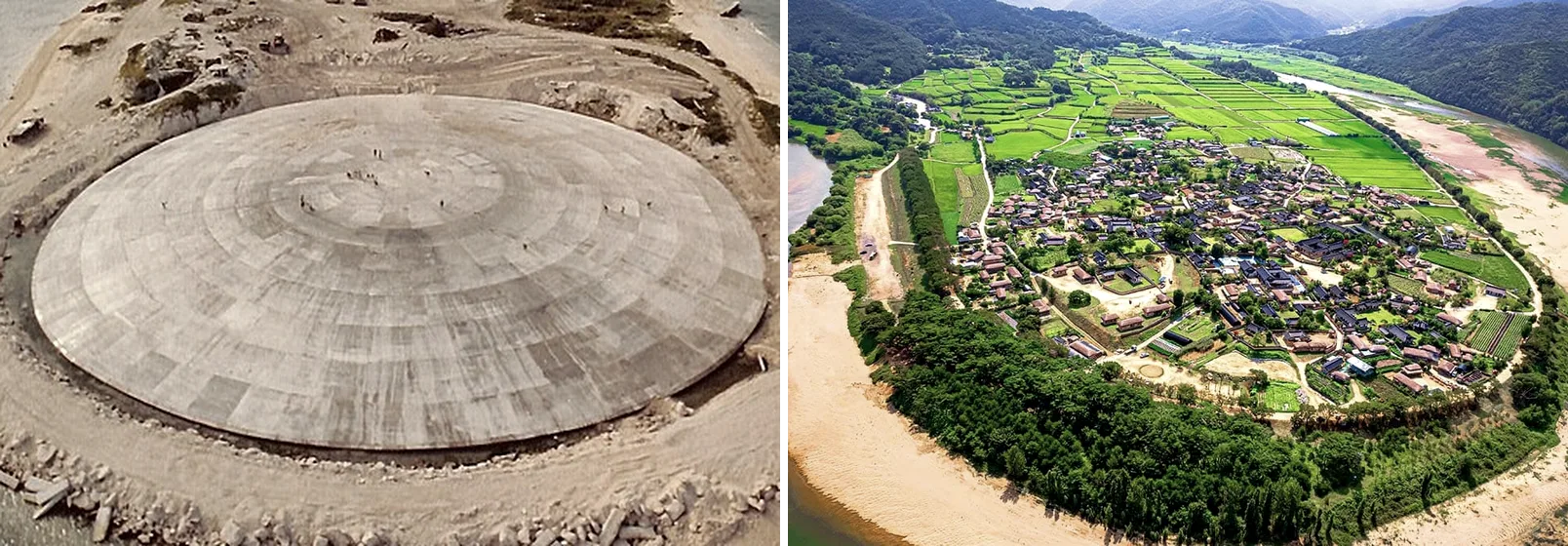
(Photos: U.S. Defense Special Weapons Agency, public domain / Korea Tourism Organization PhotoKorea, Angenieux Film)
The film Oppenheimer shows Los Alamos, a town of scientists built on a dry mesa in New Mexico. In 1943 the United States gathered its best scientists on that remote plateau. They lived behind a fence with their families and raced toward a single goal they could not mention to anyone outside.
That town gave birth to the bomb. “Gave birth” is not just a figure of speech. The bomb dropped on Hiroshima was called Little Boy. When the first hydrogen bomb test succeeded in 1952, the physicist Edward Teller sent his colleagues at Los Alamos a three-word telegram: “It’s a boy.” They announced the birth of death in the language of childbirth.
From Bomb to Tomb
The bomb left tombs. Not only in Hiroshima and Nagasaki. On Enewetak Atoll in the Marshall Islands, where the United States ran dozens of nuclear tests between 1946 and 1958, the radioactive debris from those tests was pushed into a blast crater and capped with concrete. Its official name is Runit Dome. The people there call it “the Tomb.”
Not all the scientists stayed silent. Some of them, once they understood how what they had built would be used, tried to stop it. In June 1945, scientists in Chicago wrote the Franck Report, arguing against using the bomb on Japan without warning. In July, Leo Szilard and some seventy colleagues wrote a petition to the President. Those voices did not change the decision. An attempt to circulate the petition inside Los Alamos came to nothing, and the petition did not reach the Secretary of War until August. The problem was not that no one asked. It was that the road from the question to the decision was narrow. Oppenheimer carried that weight for the rest of his life.
We often hear AI called “the new Manhattan Project.” Speed matters, no doubt. But there is a question to ask alongside it: what will it give birth to this time?
A Philosopher Outside the Academy, and a Monastery on a Lake
One philosopher has been holding on to the same question. Tobias Rees, born in Germany, founded and led the Transformations of the Human program at the Berggruen Institute, which asks how AI and biotechnology change what we mean by “human”; he is an AI2050 Senior Fellow of the foundation Eric Schmidt started, and he now runs limn, a small studio where philosophy, art, and technology meet. One of my English essays started an exchange of writing between us.
He has described AI as a philosophical earthquake for Europe, an eleven on the Richter scale: the concepts Europe built over 2,500 years, such as the human, reason, and consciousness, are shaking. And because AI itself has no meaning, he says, people have to build the spaces where meaning gets made. In an interview with Noema he points to the Bauhaus of 1919 as a model for such a space: a school where artists, craftsmen, and architects came together in the face of industrialization.
Around the same time, a similar experiment began on a quiet peninsula on Lake Lucerne in Switzerland. On the grounds of a convent that the Baldegg Sisters looked after for two centuries, and where they founded the region’s first school for girls, a school called Stella Matutina, which Rees co-founded and leads, is taking shape. It is a place of learning for people who move between philosophy, art, science, business, and technology. It calls itself a site of “philosophical R&D,” the same name limn uses for itself.
They chose the oldest form there is to hold the newest questions. A place where people live together, ask together, and spend their days to the same rhythm. Where nuns once held children close and taught them, new questions are now held. It is the opposite of a laboratory behind a wall.
From Tomb to Womb: Hahoe
Andong already has a vessel like that.
Hahoe (河回) means “where the river turns back.” The Nakdong River wraps around the village in the shape of a taegeuk, the swirl at the center of the Korean flag. It is a peninsula held by water, a land like a mother’s embrace.
On that river stands Byeongsan Seowon (병산서원), a Confucian academy. A seowon was a place to study, a place to hold ancestral rites, and a place to eat and sleep together. Lectures (講學), rites (祭享), and shared life were one body. The form the monastery on the lake is looking for now has stood here for four hundred years.
Across the river from Hahoe, at the foot of the Buyongdae cliff, is Okyeon Jeongsa (옥연정사). It is where Ryu Seong-ryong wrote the Jingbirok (징비록, 懲毖錄) after he withdrew from office at the end of the Imjin War, the Japanese invasions of 1592 to 1598. Its title is usually rendered The Book of Corrections, and its idea, jingbi (징비, 懲毖), means to reflect on past mistakes so as to guard against the future. It is not the record of a war won. It is the record of a country that collapsed. Ryu looked straight at a war that left countless graves and turned it into wisdom to protect the days that would follow.
Hahoe’s shrines and rites have done the same work. They did not leave the departed in their graves to be forgotten. They called their names and brought them back to stand beside the living. The novelist Han Kang, in Human Acts, asked whether the dead can save the living. Hahoe is a village that answered yes long ago. A village that has been turning the tomb into a womb.
Andong’s Scientists’ Village
Now a K-Scientist Village is going up in Pungcheon, next to the new town around the Gyeongsangbuk-do provincial government in Andong. The province is building it, with the architect Seung H-Sang among its designers. It has 38 residential buildings with 45 homes and 9 shared buildings, and it is due to be finished at the end of this year. Nine scientists, in nuclear energy, medicine, robotics, AI, the humanities, and other fields, are already working as K-Scientists. Around eleven more will be chosen this year, and they will move into the village together from the first half of next year.
Scientists gathering to live in one village: in that, the start resembles Los Alamos. But a similar start can lead down a different road. Los Alamos put up a fence and raced toward one goal. Andong’s village can open its gates and turn toward the river and the villages around it. Los Alamos gave birth to the bomb. I hope Andong’s village becomes a womb that carries a new civilization.
It means a great deal that nuclear scientists are among the residents. They have worked on energy and safety, not weapons, yet they know better than anyone the light and the shadow of what Los Alamos left behind, and the history of questions that never reached the decision. When people who know that weight help write a different ending, the story is at its strongest. Jingbi goes deepest in those who know the weight.
The nine, and the eleven who will soon join them, each bring deep expertise, and that expertise is in itself one of the village’s great assets. But nine research projects in one place is not the same as nine people forming one village. A village begins with the rhythm of its first day. When days for studying together are set, and the road to Hahoe and Byeongsan becomes part of daily life, this place will become more than housing for scientists. It will become a village.
How It Becomes a Womb
There is no need to start with a big program. Nor will a single event do it. In short, what is needed is space holding: keeping and sustaining a place where conversation can happen.1 I hope the village’s scientists, residents of Hahoe and Byeongsan, and people from the humanities meet again at set times, and that from the start there is a road for the questions they raise to reach the actual research and how the village is run. Los Alamos had questions too. But the road from those questions to the decision was open only to a few.
That place is not only a meeting room. Walking together along the river, or sitting without a word in the Mandaeru pavilion at Byeongsan and watching the water, is part of it too. Good questions often come in rest. And I hope someone holds that place: keeps the dates, welcomes people, and stays close so the conversation does not break off.
From that place, these could grow. All of them touch two of the roles the province has given its K-Scientists: convergence research and bringing science to the public.
- A rhythm of studying together: the Scientists’ Village lecture circle. Once a month, the village’s scientists ask about each other’s fields. The nuclear scientist asks about the health system; the AI researcher asks the humanities scholar. When it repeats on a set day in a set place, like the lectures at Byeongsan Seowon, a circuit of community forms between nine separate lines of research.
- A place that opens the door: the Hahoe Global Residency. Thinkers, artists, and engineers from abroad, people like Rees, stay for a few weeks and work alongside the scientists. One can even imagine a sister relationship in which the monastery school in Switzerland and the scientists’ village in Andong send people to each other.
- A vessel for memory: a regional memory archive. Andong holds a wealth of classical Korean texts and the life memories of countless elders. First promising each speaker consent and the limits of how their words will be used, and then working inside that promise, the village takes on the job of recording these memories in a form AI can learn from. The mathematician Terence Tao, in a conversation after writing a paper on human thought in the age of AI, pointed out that today’s AI learns only from the record of successes, and never from the process by which people get stuck, go wrong, and find their way again. Recording not only success but failure and recovery is exactly what the Jingbirok did.
- A place that puts the question before the world: the Byeongsan Forum on AI and Civilization. Once a year, a forum at Byeongsan Seowon asks about civilization after AI. The village’s scientists, the residents from abroad, and local people sit at one table. A conversation that could not happen in Seoul or in Pangyo, Korea’s tech hub, happens in Andong.
Closing: Bomb, Tomb, Womb
Seoul will become the center of AI administration, and Pangyo the center of the AI industry. So what can Andong become? I believe Andong can become the place that takes on the questions of civilization after AI.
Making technology act in line with human intentions is called AI alignment. Andong can speak to what lies beyond it: beyond the alignment of technology, toward the jingbi of a civilization. The future opens from how we interpret the past.
Bomb and womb are one letter apart. One explodes and makes graves; the other holds and gives birth to life. Los Alamos gave birth to the bomb, and the bomb left tombs. For hundreds of years, Hahoe has been turning tombs into a womb.
Now it is the scientists’ village’s turn to reach that embrace.
References
- A final interview with Edward Teller, American Heritage
- Artificial Intelligence and the 2500-year-old project called Europe, Freiburg Institute for Advanced Studies
- Why AI Is A Philosophical Rupture, Noema
- Prof. Dr. Tobias Rees, F.A.Z. Europakonferenz speakers
- Mathematical methods and human thought in the age of AI, Klowden & Tao, arXiv
- Gyeongbuk’s 2026 K-Scientist call, Etoday (in Korean)
Footnotes
-
Space holding means opening and protecting a place where people can think together instead of trying to win. Ronald Heifetz of the Harvard Kennedy School argued that organizations working on problems without easy answers need such a “holding environment.” The physicist David Bohm left the same idea as a way of meeting he called dialogue. He had been Oppenheimer’s student, but a security review kept him out of Los Alamos. ↩

Comments