Hahoe Village, an Integrated Circuit of National Memory
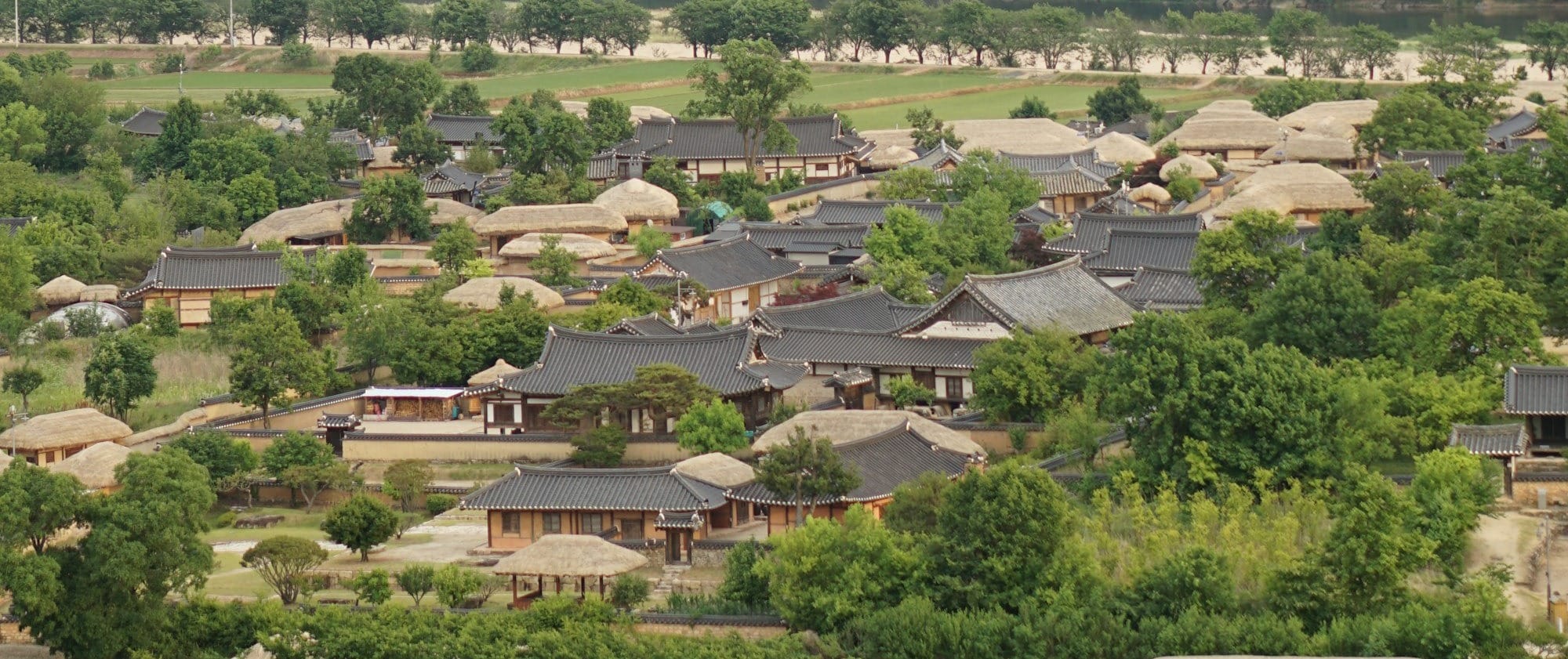
Hahoe Village in Andong is a place where the history and spirit of Joseon, the dynasty that ruled Korea from 1392 to 1910, have settled layer upon layer. It is more than a traditional village. It is a living treasury of Korean cultural heritage.
The best-known figure of the Pungsan Ryu clan, the family that has lived in Hahoe for six centuries, is Ryu Seong-ryong (1542-1607). He recorded, and reflected deeply on, a national catastrophe: the Japanese invasions of 1592, the Imjin War. As chief state councillor under King Seonjo, he led the government through the war, and afterward he set down its brutal reality and the lessons he drew from it in Jingbirok (징비록, 懲毖錄), the “Book of Corrections.”
Jingbirok is not merely a personal memoir. It was a guide to how a Confucian state should keep and manage its historical memory. Jing (징, 懲) means to take a lesson from past wrongs; bi (비, 毖) means to guard against the dangers ahead. Through it, Ryu Seong-ryong meant to record history’s bitter lessons carefully and pass them on to those who came after.
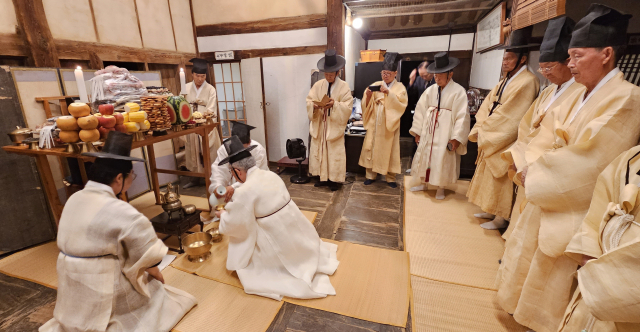
Joseon did not leave memory as writing alone. By enshrining memory in space, in the body, and in ritual, it built a systematic ethical structure meant to keep history’s mistakes from being repeated.
At its center stood the ancestral shrine and the spirit tablet, and above all the bulcheonwi (불천위, 不遷位), literally “the tablet that is never moved.” A bulcheonwi is a person whose tablet the royal court specially ordered never to be retired, to be honored with rites in perpetuity. It means that this person’s existence and deeds were recognized as public memory the state must never forget.
Most ancestral rites end after four generations, but a bulcheonwi never disappears. The tablet goes on living in the memory of descendants and community, and becomes the center of a public ritual that resists repetition and forgetting.
The bulcheonwi of Chunghyodang in Hahoe is Seoae Ryu Seong-ryong. In the national crisis of the Japanese invasions he fought, at the risk of his life, to protect Confucian ethics and the lives of ordinary people, and he carried the scholarship of the Toegye school, the lineage of Yi Hwang, Joseon’s foremost Neo-Confucian thinker, into real politics.
So the bulcheonwi rite at Chunghyodang is not simply a family memorial. It is the complete representation of the political ethics, the intelligence, and the way of enduring suffering that Joseon, as a civilization, wanted to remember.
Today, in an age when public memory has grown light and collective ethics have collapsed, the bulcheonwi asks again. “What will we remember forever?” “Whose name, and which ethics, must be called again so that history does not repeat itself?”
The bulcheonwi, then, is not only a rite for honoring the dead. It is an ethical oath the living repeat so as not to forget, a ritual of the circuit. And that central circuit is coming back to life now, in Hahoe.
The site of Hahoe, a circuit in the landscape
Hahoe sits in a natural whorl of terrain, where the Nakdong River wraps itself around the village. This meander is not just a curve in the water. It creates a spatial structure in which time and memory linger, swirl, and return.
In pungsu (풍수), Korean geomancy, better known in the West by its Chinese name feng shui, this form is called poguk (포국, 抱局), an “embracing configuration.” Instead of letting energy flow through, it absorbs it, holds it, and circulates it slowly, like a vessel. That is why Hahoe became not a mere village but a “vessel of memory,” with the silent breath of ancestors inscribed in the land itself.
The name Hahoe (하회, 河回) itself carries a deep meaning. On the surface it means “the river turns back.” Within it is a returning wave: “a place where what was forgotten comes back, and what must return stays.”
So Hahoe is not just a preserved space. It is a ritual center that sorts out and realigns the circuit of recurring pain and history. Here, time is not a line but a circle, and memory is not the past but the present.
The summit of the aristocratic system of rites and music
Hahoe is not simply a traditional village. It is the most refined system in which the whole of Joseon’s Confucian civilization was realized through ritual, space, and art, a place where the structure of life that designed and maintained memory still stands intact.
Here,
- the head-house system, in which the primary heir lives on, generation after generation,
- the shrines and family temples where ancestral tablets are enshrined,
- Byeongsan Seowon, the Confucian academy that established Neo-Confucian education and the ethics of the state,
- the bulcheonwi, a national rite that descendants are bound to perform,
- and the Hahoe Byeolsingut Talnori (하회별신굿 탈놀이), the mask dance that gave voice to the community’s pain, resistance, and purification
are woven together, space, time, body, and spirit, like a single circuit.
It amounts to a blueprint in which rites hold memory, memory builds space, and that space sustains the ethics of the community.
Hahoe, you might say, was a vessel of memory and the data center of Joseon’s Confucian ethics. And all of this runs like a wave through Hahoe’s land, river, wind, etiquette, dance, and ancestral rites.
That is why Hahoe is not a folk village but the ritual engine of Joseon civilization, a public stage of memory where life and death are joined.
Why Hahoe is where Joseon’s public memory is most concentrated
In Hahoe, Ryu Seong-ryong as keeper of memory, Jingbirok as record of reflection, the bulcheonwi as a device for enshrining memory, the system of rites and music, and a singular geography all come together. It is the real place where the collective memory system of the Joseon Confucian state was most precisely realized.
Here the answer to “how did Joseon remember, and what did it refuse to forget” is condensed into a complete circuit: space (the land of Hahoe), people (Ryu Seong-ryong and his heirs), documents (Jingbirok), and ritual (the bulcheonwi and the mask dance).
So a visit to Hahoe is not tourism or heritage viewing. It is a ritual act of reconnecting to a civilization’s memory, a journey to ask again where I stand within that memory and to realign the ethics of today.
Especially in a time like ours, when public memory is fragmented and history’s wounds keep repeating, Hahoe asks again:
“What have we forgotten?”
“What must we remember now?”
Hahoe is not a place to honor the past. It is an ethical structure that keeps memory alive. And within that structure is the place where we must be set again.
Original Korean version written on May 17, 2025. Translated into English with AI in October 2026.
Comments