Portrait of Someone Born in 1981
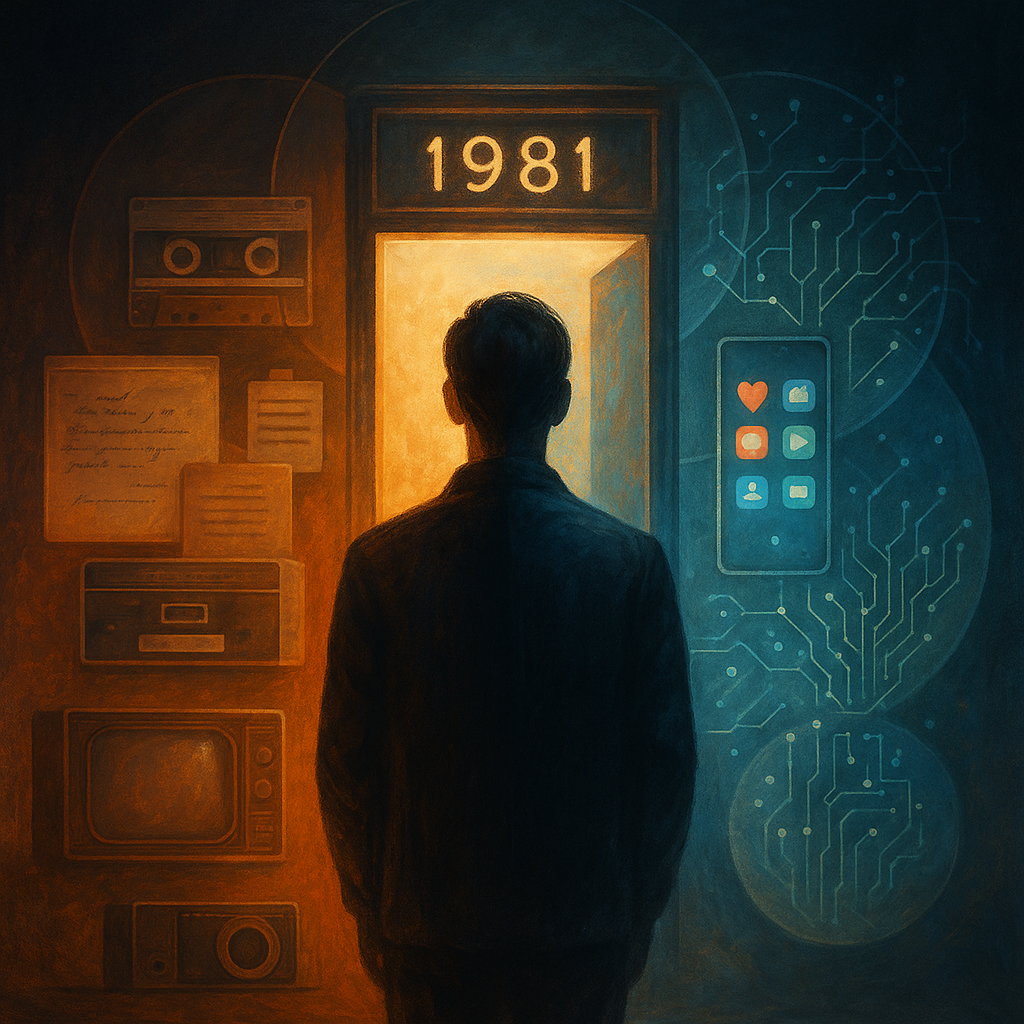
1. The Door Called 1981
- The number is a threshold. The point where the dusk of analog crosses the dawn of digital, the moment the end of the Cold War overlaps with the opening act of globalization, the strange coordinate of being the children of the industrialization generation and the parents of Gen Z. We grew up listening to music on cassette tapes and we are growing old on Spotify. We learned to program on 386 PCs and we work by talking to AI.
I was born in 1981 into the world, into Korea, and into myself. In the intersection where these three circles overlap, and in the empty spaces they leave between them, the portrait of a generation takes shape.
2. The 1981 Cohort, Worldwide
Witnesses to a Turning
Those of us born in 1981 stand on history’s hinge. In 1991, the year we turned ten, the Soviet Union collapsed. In 2001, the year we turned twenty, 9/11 happened. In 2008, before we turned thirty, Lehman Brothers fell. In 2021, the year we turned forty, a pandemic shook the world. Every decade, we passed through an inflection point of world history.
This is the last generation to hold analog sensibility and digital literacy at the same time. We know how to write a letter by hand and how to send an email. We post photos shot on film to Instagram. We know the weight of a book and the convenience of a Kindle. This doubleness is not a weakness but a strength. We are translators. Between the past and the future.
Broken Promises
As the older cohort of the millennials, we were the first generation to watch the promise “work hard and you will succeed” come apart. The moment a university degree stopped being a ticket to the middle class, the moment the lifetime job became a myth, the moment a single home became a lifetime of debt: we saw all of it in our twenties.
So we began to live differently. More of us chose experience over ownership, meaning over stability, balance over climbing the ladder. Digital nomads, freelancers, founders, and experimenters in every kind of alternative life. Those born in 1981 became the generation that always keeps a Plan B.
Now and Later
In 2025, the world’s 1981 cohort is 44. Politically younger than Macron (born 1977), economically older than Zuckerberg (born 1984). We now occupy the seats of middle management, mid-career entrepreneurs, seasoned professionals. Not yet at the top, but the core gears that keep the work turning.
Ten years from now, at 54, we will be the decision-makers in our fields. Twenty years from now, at 64, we will not be elders on the verge of retirement but senior leaders still at work. In an age of hundred-year lives, 64 is the new middle age.
3. The 1981 Cohort in Korea
IMF Kids
For Koreans born in 1981, 1997 is a wound that does not close. That was the year of the Asian financial crisis, which Koreans still call simply “the IMF,” after the bailout that came with it. We were 17, in our second year of high school, and we watched our fathers fall. Fathers pushed out of the conglomerates they had believed were jobs for life. Neighborhood uncles turned out onto the street under the name of restructuring. Mothers pulling off their wedding rings for the national gold drive, when ordinary people handed over their gold to help pay down the country’s debt. That is when we learned: there is no such thing as security.
When we entered university in 2000, we caught the last tail of the student movement built by the 386 generation (Koreans born in the 1960s, in university in the 1980s, in their thirties in the 1990s: the generation that fought for democratization, named after the Intel 386 chip). But our attention was already elsewhere. The venture boom, the internet, globalization. We founded venture clubs instead of joining the activists, we wrote blogs instead of hand-lettered wall posters, and we dreamed of startups instead of revolution.
The First Generation of Hell Joseon
In the mid-2000s, when we entered the workforce, Korea was already becoming “Hell Joseon,” the slang that fuses the name of the old dynasty with hell, for a country where you are born into your station and cannot climb out. The “880,000-won generation” was coined for us, after the monthly pay of a young temp worker. We became the “sampo generation,” the ones who gave up three things (dating, marriage, children), and then the “opo generation,” who gave up five (add a home and a career). Starting with us, irregular employment became ordinary, the arms race of credentials reached its peak, and we became the first generation to live worse than our parents.
But we are also the generation that made the Korean Wave. We experimented with digital culture on Cyworld, Korea’s social network before Facebook. We made new music in the indie scene around Hongik University. We lived global culture at Gangnam Station and in Itaewon. We created while we despaired, and we kept trying while we gave up.
A Present That Splinters
In 2025, Korea’s 1981 cohort is deeply split. Some have become executives at conglomerates; some still drift from one temporary contract to the next. Some own two apartments in Gangnam; some still pay monthly rent. Some send their children to private elementary schools; some have given up on having children at all.
We are split politically too. Progressive and conservative, feminist and anti-feminist, pro-American and pro-Chinese: every front line runs through our generation. We do not bind into a single identity the way the 86 generation (the 386 generation, minus the chip, now that they are no longer in their thirties) did. We are a loose collection of fragmented individuals.
Ten years from now, we will be the backbone of Korean society. But we will not color society in a single shade the way the 86 generation did. Twenty years from now, in a Korea that has become a super-aged society, we will be the elderly who still work. Retirement will be a luxury.
4. My (Hahn’s) Life and Lifestyle
Between Ordinary and Different
While the average Korean born in 1981 threw himself at the big company and the apartment, I walked a different road. From startups to blockchain, from Seoul to Andong, from capitalism to DAOs. My life sat on the far side of the 1981 average.
This is not evidence of superiority. Just a different experiment. Some people contribute to the world through stability, others through change. I chose the latter. Or perhaps the circuit inside me led me there.
Three Trajectories
The first is the vanguard of technology and the economy. From the earliest days of startups to blockchain, the front line of the economic possibilities new technology creates. There were many failures, and those failures made me.
The second is the rediscovery of history and spirit. Returning to Andong was not a change of address. It was a journey into the five hundred years of a family’s time. The work of realigning my ancestors’ circuit with my own.
The third is experiment in politics and philosophy. Wind & Flow DAO. A third kind of organization, neither state nor corporation. A third economy, neither capitalist nor socialist.
Experiments Become Institutions, Institutions Become Memory
At 44, I am still experimenting. But now the experiments have begun to connect. Technology and spirit, economy and philosophy, individual and community converge into one picture.
Someday these experiments will become institutions. Maybe a school, maybe a company, maybe a community. What matters is not the form but the spirit. And those institutions will in turn become memory. I do not want to be remembered as someone with power, but as someone who wired circuits. New circuits connecting human consciousness and the structure of systems. Someone who left meaning rather than success, influence rather than dominion.
5. Conclusion: Generation, Era, Me
The portrait of someone born in 1981 is a mirror of the age. We are transitional beings living in a transitional time. Born too late to catch the golden age, born too early to be natives of the new one. But precisely because of that, we could become translators.
The world’s 1981 cohort is becoming leaders in search of meaning. Korea’s 1981 cohort has become splintered pillars, each holding up society in their own way. And I, at the intersection of all of it, am rewiring the circuit.
This is a portrait of someone born in 1981. Not a finished painting but a sketch still being drawn. The self-portrait of a generation, contradictory and dynamic, carrying the past while walking toward the future. We may fail. But at least it will be recorded that we tried.
Having passed through the door called 1981, we are now walking the corridor called 2025. And we still ask: who are we, and where are we going? There is no answer. But to keep asking, never to stop asking, that is the portrait of someone born in 1981.
Original Korean version written on August 25, 2025. Translated into English with AI in October 2026.
Comments