Paper Folded Twice
A Line on the Table
Draw a line on the table with your finger. Put South Korea in the middle. North Korea on the left, Japan on the right. Beyond North Korea, China; beyond Japan, the United States. Lay the five out on one line like this, and a familiar map turns a little strange.
The map we learned is a map of two camps. South Korea, the United States, and Japan on one side; North Korea, China, and Russia on the other. The demilitarized zone is where the two camps meet, and South Korea stands at the very front edge of one of them. On this map South Korea can do only one thing: decide which side to lean toward, and how far.
The map on the line is different. South Korea is in the middle. The demilitarized zone and the Korea Strait become the same kind of line. Neither is the border of a camp; both are lines where we touch a neighbor inside one region. China and the United States step back into an outer ring, as large neighbors around this region.
In that moment North Korea and Japan stand in the same place. Both are next-door neighbors with whom we share a wounded history, and both have a large patron behind them. The structure is a mirror image.
Then the two oldest insults inside Korea become mirror images too. One side calls the other chinil, pro-Japan; the other side calls the first jongbuk, pro-North. They sound like opposites, but on this line they are the same gesture. Both say “you have leaned toward one of the neighbors inside our region,” and both accuse the other of picking a side instead of standing in the middle.
The Ring
Keep stretching the line in both directions.
Past North Korea lies China, and past that, Russia and Central Asia, and then Europe. Past Japan lies the United States, and across the Atlantic beyond it, Europe again. The line we took for straight was a ring around the globe, and the two roads meet in Europe.
Only then can we see where the two forces that split the peninsula came from. The Soviet Union and socialism that came down from the continent, and the United States and liberalism that came across the sea, both grew from European modernity. Two arms set out from Europe, went around the globe in opposite directions, and collided on the Korean Peninsula. The division is the mark where those two arms met.
At the far end of the ring, on the threshold where Europe meets Asia and Africa, stands Israel. At the near end stands South Korea. Beside Israel stands Europe’s perpetrator, Germany; beside South Korea, Asia’s perpetrator, Japan. The two ends of the ring repeat the same structure.
A Table of Four Cells
Put the four countries into four cells using two questions. Did it start the war, or suffer it? And afterward, was it divided, or not?
This table is not an interpretation. It only puts four facts everyone knows into four cells. But once they are in, one thing stands out. In Europe the split landed in the perpetrator’s cell. In Asia it landed in the victim’s.
Like a decalcomania, where you fold paper to press paint from one side onto the other, the picture of Europe pressed onto Asia came out the same except for one color: the paint called “division” bled into the opposite cell.
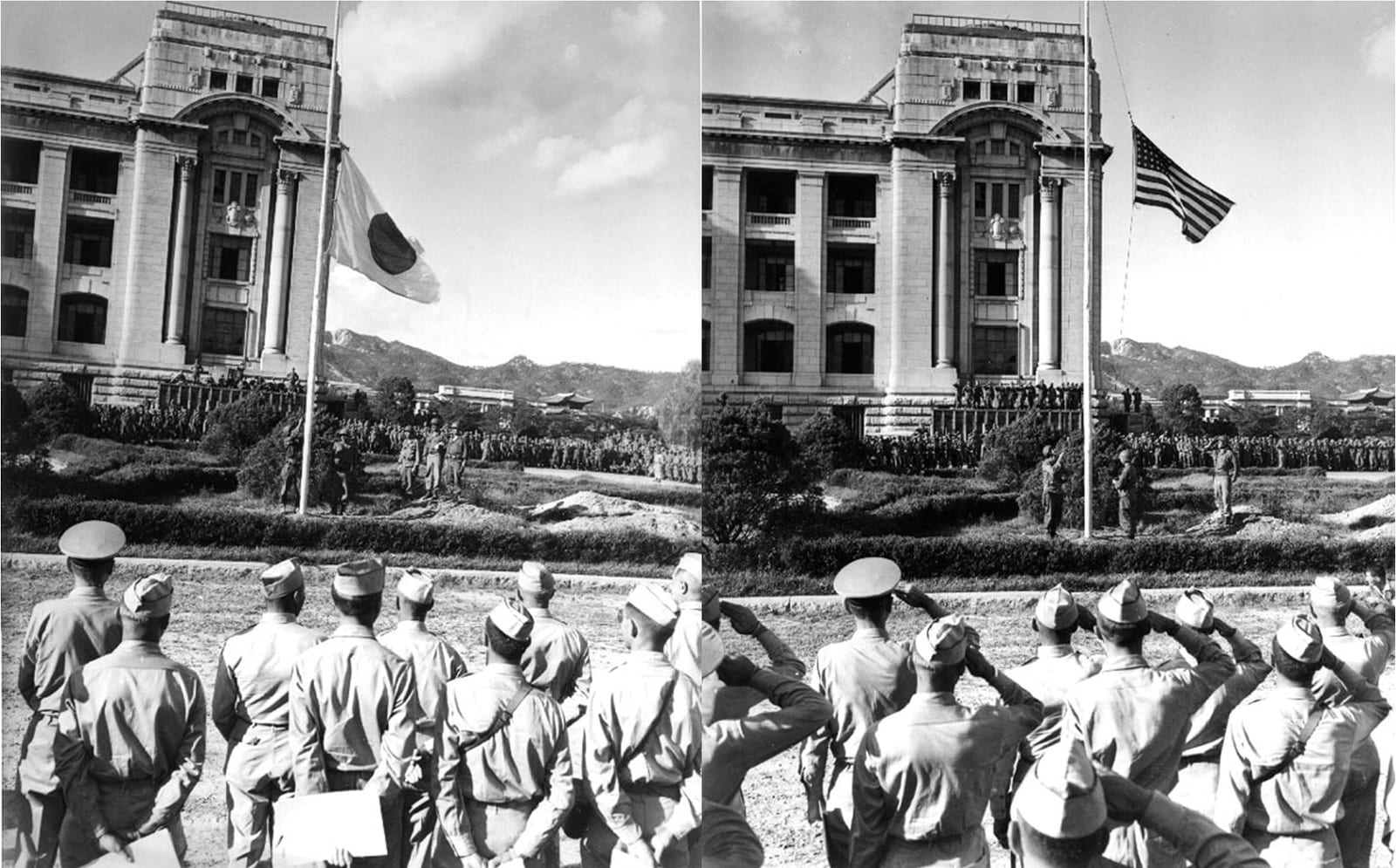
(US Navy photos, public domain, Wikimedia Commons)
None of this was fixed from the start. On the night of August 10, 1945, two American officers chose the 38th parallel in about thirty minutes. It was a line for the United States and the Soviet Union to divide the surrender of Japanese troops. In other words, the 38th parallel was from the beginning a line of Japan’s surrender. On the 16th of that month, Stalin asked Truman to let the Soviet Union occupy the northern half of Hokkaido. Truman refused. There was a moment when Japan could have been divided like Germany, and the blade fell not on Japan but on Japan’s former colony.
(base map: Natural Earth)
Taiwan too. The island that was Japanese territory from 1895 to 1945 became, after 1949, the stage on which China split. Both of East Asia’s divisions, the two Koreas and the two sides of the Taiwan Strait, lie on the former lands of the fallen Japanese empire.
Two Folds
Fold the table in two directions.
Fold it horizontally, by perpetrator and victim, and Korea lands on top of Israel.
| Israel | Korea | |
|---|---|---|
| The meeting that set its fate | UN General Assembly Resolution 181, November 29, 1947 | UN General Assembly Resolution 112, November 14, 1947 (same session, fifteen days apart) |
| Founding | May 14, 1948 | August 15, 1948 (three months apart) |
| The line it lives on | 1949 armistice line (the Green Line) | 1953 armistice line |
| Money from the perpetrator | 1952 Luxembourg reparations agreement | 1965 claims agreement |
| Anger in the streets | January 1952, protesters against reparations stone the parliament | June 1964, martial law in Seoul over the June 3 protests |
| A protester who rose | Begin, prime minister in 1977 | Lee Myung-bak (one of the leaders), president in 2008 |
| Relations with the perpetrator | with West Germany, May 12, 1965 | with Japan, June 22, 1965 (six weeks apart) |
Table 1 · Folded horizontally: Israel and Korea
Fold it vertically, by divided or not, and Korea lands on top of Germany.
| Germany | Korea | |
|---|---|---|
| Direction of the split | East and West | North and South |
| The gate across | Checkpoint Charlie (foreigners, Allied personnel, and diplomats only) | Panmunjom |
| The hand held out | Brandt’s Ostpolitik | Kim Dae-jung’s Sunshine Policy |
| Joining the UN together | September 18, 1973 | September 17, 1991 (eighteen years and one day apart) |
| Unification | October 3, 1990 | Not yet |
Table 2 · Folded vertically: Germany and Korea
Korea sits in the cell where the two folds cross. A country that stands in the victim’s place yet carries the perpetrator’s fate. It bears Israel’s place and Germany’s fate in one body.
One Root
Why did the paint bleed that way?
Germany was one people split in two. The perpetrator’s body was divided. To see something similar in Asia, you would have to see Japan and the Korean Peninsula as one large body grown from a single root. The people who crossed from the peninsula in the Yayoi period; the toraijin who sailed from Baekje and Gaya; and in 2001, Emperor Akihito citing the Shoku Nihongi, which records that the mother of Emperor Kanmu descended from King Muryeong of Baekje, to say he felt a kinship with Korea. Gather these, and the picture becomes one of a large body that started a war and was divided, only the blade fell not on the Japanese branch but on the branch that had become a colony.
This picture of “one root” looks on the surface like Nissen dōsoron, the theory of common ancestry that Japan used to justify colonial rule. That is why it has to be said with more care. What is meant here is not blood but structure: two branches bound inside one imperial order.
In Europe the tangle has another shape. Germans and Jews are not one root. But Jews lived inside German lands for more than a thousand years. In medieval Hebrew, Ashkenaz was the word for Germany, and Yiddish, the language of European Jews, grew out of German.
| Europe | Asia | |
|---|---|---|
| Perpetrator and victim | The victims lived inside the perpetrator’s body | Perpetrator and victim were two branches of one imperial order |
| The shape of the violence | Trying to erase the people living inside (the Holocaust) | Trying to graft the other branch onto its own body (forced name changes, naisen ittai, banning Korean) |
| Where the split fell | The perpetrator’s body | The other branch of the same order |
Table 3 · Violence that erases, violence that swallows
Violence that erases and violence that swallows. This, too, is one pair of the decalcomania.
The Crease
Now back to the two insults we began with.
If the division of North and South is the first split, then the fight inside South Korea, where people call each other pro-Japan and pro-North, is the second: the division folded back into the country.
It is no accident that the split inside the country runs along the two axes of Japan and North Korea. The division born when the Japanese empire fell landed on Korea instead of Japan, and that division then folded back into Korean society.
That the country splits over its stance toward Japan and its stance toward North Korea is itself the trace of Korea carrying a division Japan did not carry.
We have long treated these two fights separately. The pro-Japan question as the homework of a reckoning that failed after liberation; the North Korea question as the homework of the division system. But on the four-cell table they are two faces of one division. Not two fronts, but one crease.
Brandt’s Day
In Germany these two tasks lived inside one person.
On December 7, 1970, Willy Brandt knelt before the Warsaw Ghetto memorial. On the same day he signed a treaty with Poland recognizing the eastern border. Facing the past and reaching out to the divided other half, jingbi and unification, went together in the same day of the same man. Twenty years later Germany was one. It is also worth recording that this same Brandt wrote to Chun Doo-hwan in 1980 asking him to spare Kim Dae-jung, who had been sentenced to death.
In Asia these two tasks fell to different countries.
| Germany | Asia | |
|---|---|---|
| The share of jingbi (facing the past) | Germany | Japan |
| The share of unification (reaching out to the other half) | Germany | Korea |
| The body that carries both | One body | Two bodies |
| The one who knelt | Brandt, 1970, as sitting chancellor, on behalf of the nation | Hatoyama, 2015, at Seodaemun Prison, as a former prime minister, in a private capacity |
Table 4 · The share of jingbi and the share of unification
The share of jingbi lies with Japan, yet Japan was not divided. Korea carries the share of division, yet Korea was not the perpetrator. It is a structure in which the two cannot move together inside one body, as they did in Germany.
World-System and Division System
Parts of this picture already have names.
Wallerstein saw the capitalist world-economy that began in sixteenth-century Europe bind the whole globe into one system, and called it the world-system. The ring we saw earlier is that system. The picture of modern Europe’s two arms parting by land and sea, circling the globe, and meeting on the Korean Peninsula is the world-system colliding with itself at its own far edge.
Paik Nak-chung drew on Wallerstein to place the Korean division as a subsystem of the world-system. The division is not simply a state of two separated countries but a single system that runs through both societies, North and South, reproducing itself as the vested interests on each side need each other. That is the theory of the division system. The cell where the paint of division landed on the four-cell table is where this system sits, and the crease is the shape of that system reproducing itself inside South Korean society.
Lay the three layers on top of one another and you can see what this picture adds to the two theories.
One is comparison. The theory of the division system explained the Korean Peninsula, and often compared it with Germany. The four-cell table adds Israel and Japan, and asks why the two divisions the world-system produced in the same years fell once on a perpetrator and once on a victim.
The other is the pro-Japan question. The theory of the division system saw the South-South conflict as a fight over North Korea. The crease says the other edge of that fight points at Japan. The pro-Japan dispute is one more way the division system reproduces itself.
And through this window we can see again what Paik called the transformative middle way. It does not mean picking the midpoint on the plane of pro-Japan versus pro-North. It means standing where one tries to change the system that makes the plane. That is the work of going from 2 to 3.
Acupoints
The system is large and wide, but there are small places where its contradictions condense all at once. Baik Young-seo called them core sites. Okinawa is one. I would add Kinmen, Kaesong, and Andong. The line of five countries, the ring around the globe, and the four-cell table are all folded into places like these. Like a fragment of a hologram, one small piece holds the whole.
Okinawa and Berlin. Okinawa is a victimized periphery inside the perpetrator. The Ryukyu kingdom, annexed in 1879, became the shield for the defense of the main islands in 1945, was under US occupation until 1972, and still hosts most of the US bases in Japan. Berlin was a city inside the perpetrator, divided by occupying armies. But Berlin was the capital and Okinawa a periphery, so center and edge are reversed.
Kinmen and West Berlin. Kinmen and Xiamen are two shores within sight of each other across the water. Over a sea once crossed by shells, Teresa Teng’s songs crossed too, and in 2001 the “Mini Three Links” made it the first place where ships ran. West Berlin was an island lodged in the middle of the other camp. It survived on an airlift, and radio and television crossed the wall. Of the four, this is the closest pair.
Kaesong and Erez. Kaesong is a former capital and a city just north of the armistice line. From 2004 to 2016, Southern capital and Northern labor met in one industrial complex. The Erez Industrial Zone on the Gaza border was also a joint Israeli-Palestinian zone, but it closed in 2004. That Germany never had a joint industrial zone on the inner-German border is itself an asymmetry.
Andong and Weimar. The most conservative Confucian region produced the most independence activists. The Jingbirok of the Imjin War and the reformist Confucians who went to Manchuria come from the same region. In Hahoe, Confucianism meets shamanism, and the nobility meets commoners. Beside the academies and head houses, villagers held a shamanic rite for the village guardian and, wearing masks, made fun of the nobility. In 2024 a statue of Park Chung-hee went up in front of the provincial government, and the place across from it stands empty; yet Kwon Roh-kap, Kim Dae-jung’s lifelong comrade, and President Lee Jae-myung were both born here. Perpetrator and victim, conservatism and resistance, East and West are folded into one region. Weimar is Goethe’s city with Buchenwald beside it; Germany’s first democratic constitution came from here, and it lay in East Germany. The height of culture and the bottom of violence in one region.
These places are like acupoints. The illness of the whole body gathers at one point, and pressing that point moves the whole body. When ships left Kinmen, the two sides of the strait opened; when the industrial complex rose in Kaesong, North and South opened and then closed again. But pressing an acupoint does not cure everything. The bases in Okinawa are still there, and Erez is closed. An acupoint is a place of possibility, not of guarantee.
予其懲
Here let us read again the opening of Seoae’s book.
The title Jingbirok comes from a line in the Book of Songs.
予其懲而毖後患
I will reprove myself for what has passed, and be wary of troubles to come. The subject of this sentence is 予, I. It does not say I will punish the enemy; it says I will look back at myself. It is a book by the chief minister of the side that suffered the war, neither its winner nor its loser, written with himself as the subject.
What a country standing in the victim’s place yet carrying the perpetrator’s fate can do lies inside this subject. Germany did jingbi and unification as a perpetrator. Korea may be the first country that must do both as a victim: to gather the memory of harm as Israel did, and to turn that memory into responsibility and reconciliation as Germany did, within one body.
For that, jingbi cannot point only at others. In February 1968, in Phong Nhị and Phong Nhất in Vietnam, South Korean troops killed 74 civilians. Korean courts recognized the state’s responsibility twice, in 2023 and in 2025, and the government has appealed to the Supreme Court, which has yet to rule. A country with a history of being harmed also leaves wounds elsewhere. Only when those wounds, too, fit inside the subject does the character 予 carry its full weight.
The Edge of the Paper
Pro-Japan or pro-North are two choices on the same plane. On that plane the fight never ends. Whichever side you pick, the other remains, and the winner becomes the loser at the next election.
What the four-cell table shows is a place one step up from that plane. Korea is not in a place that asks which side to take; it already stands where two symmetries cross. What can it connect from the middle? The moment that question opens, the choices change. Connecting what Japan and North Korea cannot sit down to do directly, as a country that touches both. Opening the way home for adoptees and diaspora Koreans who went across the sea. Gathering scattered citizens’ memories in one place. They all come from the same place.
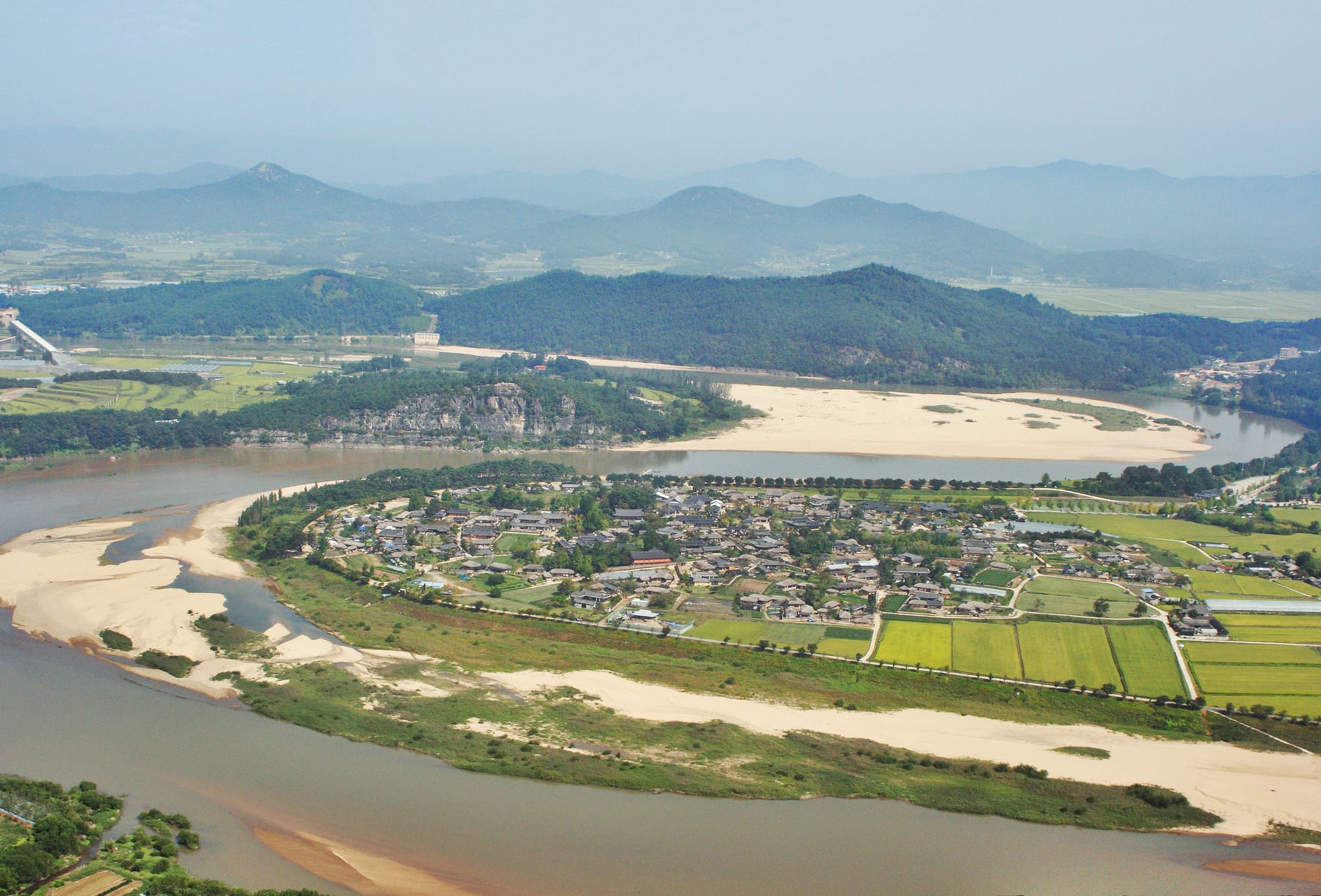
(Photo: Korea.net / Korean Culture and Information Service, CC BY-SA 2.0, Wikimedia Commons)
Back to the line on the table. South Korea in the middle, North Korea on the left, Japan on the right. Stretch the line and it becomes a ring, and at its far end stand Israel and Germany. The paper has been folded twice, and we live where the creases cross. That place is a wound, but it is also the only place where both pictures were pressed on top of each other.
Postscript
The dates and figures in this essay were checked as of October 17, 2026. The passages that see Korea and Japan as two branches of one imperial order, that contrast the violence of Europe and Asia as erasing and swallowing, and that choose European counterparts for the core sites are not lists of facts but the author’s reading.
References
- UN Resolution 112, UN Resolution 181
- How the 38th parallel was chosen, Stalin’s request for Hokkaido, Truman’s reply
- The Luxembourg Agreement and its ratification (in German), Begin’s opposition to reparations
- The June 3 protests and Lee Myung-bak (in Korean), Ratification of the Korea-Japan treaty (in Korean), Germany and Israel establish relations
- The Warsaw genuflection, Brandt’s appeal for Kim Dae-jung (in Korean), Hatoyama at Seodaemun (in Korean)
- The two German states join the UN (in German), The two Koreas join the UN
- Checkpoint Charlie, Panmunjom
- Baik Young-seo on core sites (in Korean, 2013), Kim Ho-ki on the division system (in Korean, 2015), Kim Jeong-in on the pro-Japan frame (in Korean, 2014), Choi Young-ho, Japan’s surrender and the division of Korea (in Korean, 2017)
- The Park Chung-hee statue in front of the Gyeongbuk provincial government (in Korean, 2024), Kwon Roh-kap (in Korean), Lee Jae-myung (in Korean), Hahoe Byeolsingut Talnori (in Korean)
- Phong Nhị and Phong Nhất, first ruling (in Korean), appeal ruling (in Korean), pending before the Supreme Court (in Korean)
Original Korean version written on October 21, 2026. Translated into English with AI in October 2026.

Comments