Talsang: Taking Off the Mourning Clothes
Reading the politics of Korea and the world through talsang (脫喪), the old rite of taking off mourning clothes. On how countries that never took them off might return to the place of the living without throwing their memories away.
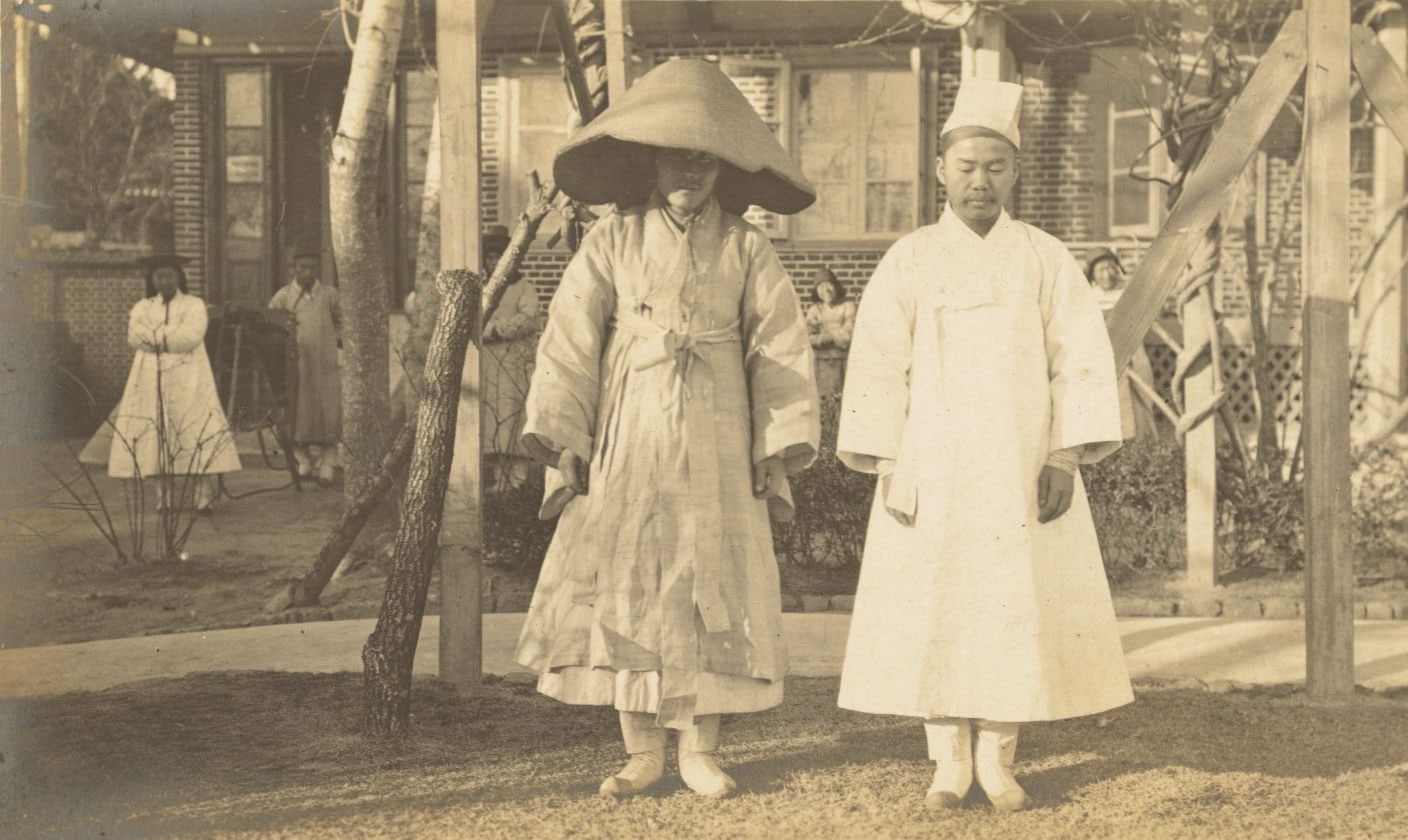
(Photo: Cornell University Library, Willard Dickerman Straight Collection. No known copyright restrictions)
The Day the Mourning Clothes Come Off
Talsang (脫喪) means taking off the mourning clothes. In the traditional Korean rites, a person who lost a parent lived in mourning for a set period. They wore hemp, stayed away from feasts and set much of ordinary life aside. When the appointed day came, they took the mourning clothes off and returned to their place.
Talsang is not forgetting. The memorial rites, jesa, go on every year after it. You do not take off the mourning clothes because you have forgotten the dead. You take them off so that the living can return to the place where they must go on living. The dead go to the place of the rites, the living to the place of daily life. Ritual (禮) set aside a time for grief, and it also laid out a road from that time back to ordinary days.
Mourning clothes are not a thought. They are clothes. You put them on your body and you take them off your body. There is a reason ritual set the end of mourning by clothing and not by the heart. The heart does not know dates. The body does.
But sometimes the chief mourner cannot take the clothes off. When the death was unjust, when the killer is still standing right there, when taking them off feels like betrayal. Such a mourner goes out into the world still dressed in mourning. The clothes stop being clothes and become an identity, and mourning stops being a period and becomes a lifetime.
Politics has times like this too. Times when a death long ago divides the sides of today, and people not yet born then inherit the fight over that death.
This essay is about a country that could not take off its mourning clothes. Korea comes first. But is it only Korea? A country still quarreling over the flags and statues of an old civil war. A country split over whether to open the graves of its dictatorship. A country that stopped speaking to its neighbor over deaths a century old. Citizens who go to the polls still in mourning clothes are everywhere. Talsang is one way of reading that politics.
Mourning Without End
Korean politics seems to have two houses of mourning.
In one there is the memory of fear. War and flight, poverty, the day they came down from the North. To those who inherited that memory, the other side looks like people who do not know that fear, or people who would bring it back.
In the other there is the memory of grievance. Torture and dismissal, Gwangju, family and friends who never came home. To those who inherited that memory, the other side looks like the people who caused the grievance, or the people who deny responsibility for it.
The two houses find it hard to mourn each other’s dead. One side’s mourning clothes look like a provocation to the other. Acknowledging their grief feels like it shrinks the justice of our own dead.
Real lives are more tangled than this division. People who fled south resisted the dictatorship, and families proud of industrialization lost children to state violence. Fear and grievance live together inside one person. The two houses are the homes of different people, and also two rooms divided inside a single person.
Politics erases that overlap and asks which side you belong to. It makes you choose your side before anyone hears what you went through. Then, of a person’s whole life, only the memories useful to their side remain.
Mourning inherited this way does not lead only to defeat. It goes on after victory too. Even after democracy was defended against the martial law of December 3, a politics that finds new enemies inside its own camp has not ended. A difference of opinion becomes betrayal, and a rival becomes a force to be put down.
Of course, not every harsh word is wrong. Acts that actually tore down the constitutional order need a fitting name and real accountability. The problem comes when the language for judging those acts becomes the language for measuring every disagreement in daily life. Then victory does not end the fight. It only moves the next one somewhere else.
The Same Plane
Why does the fight not end? Because the two houses stand on the same plane.
Winning and losing are two ends of one plane. When one side wins, the other loses, and the losing side puts on mourning clothes and prepares for the next fight. The winning side keeps checking for enemies to protect its victory. It believes the other side will strike the moment it takes its mourning clothes off, and that belief is often right.
Leave out that last fact and talsang becomes advice from someone who does not know the danger. Telling people to stop fighting does not make a real threat disappear. There have to be conditions under which a person who takes off the mourning clothes will not be hurt again.
People look for answers on this plane. Win harder, finish them off, or meet in the middle. But the middle is also a point on the plane. Standing in the middle does not change the rules of the fight.
Stepping up off the plane does not mean avoiding the fight. It means asking what makes each side keep needing the other as an enemy. Along with who wins, it means seeing why the same fight repeats even after someone has won.
In the previous essay, “Paper Folded Twice”, I looked at division as the great condition that makes this plane. The border between North and South folded inward into the South, so that a neighbor’s words and memories are read as signs of the enemy. Yet division is not the cause of every wound. The experiences of state violence and war, of labor and poverty, each have their own history and their own responsibilities to weigh. The division system binds those different wounds into a hostile sorting into sides, and keeps reproducing it.
Talsang is cutting that link. It means not erasing memory, and not letting that memory divide every relationship of today into enemy and friend.
A Middle Way That Is Not the Middle
Paik Nak-chung’s idea of a “transformative middle way” is worth reading alongside this. If the middle way means somewhere halfway between the two sides, the conditions that made the two sides stay as they are. What the transformative middle way aims at is changing those conditions.
I read it as a move from 2 to 3. It does not mean placing a third position between the two. It means gaining an axis from which you can see how two positions you thought were opposites are produced together inside one system.
Seen from that axis, the memories of the two houses sit together inside one country’s history. Placing them together does not make right and wrong equal. You cannot split fifty-fifty the responsibility of those who used state violence and the experience of those who lost family to it. But you can tell apart asking for accountability and listening to a person’s loss.
Acknowledging someone’s grief does not mean agreeing with their political judgment. Nor does it erase the wrongs of the power they supported. Giving someone a place to tell their life is different from handing them authority.
Only with this distinction can we listen to each other’s memories without losing our judgment.
And this axis is not held by thought alone. Even people who can explain the system fall back into the language of enemy and friend when they feel threatened. So talsang needs a place to return to. Procedures that let you stop when the words turn harsh, relationships where disagreement does not get you thrown out, rules that people with different memories can keep together. Ritual is one way to confirm such a place through visible action. What sets ritual apart from thought is that it is done with the body. Thought wavers in a house of mourning, but a body that takes off its clothes on an appointed day wavers less.
Who Takes Them Off First
Talsang can begin first on the side that has room to spare. The side that won, the side with power, the side that is relatively safe carries the larger share.
That does not mean the winners have nothing to lose. Threats remain after victory, and what was hard won can be taken away again. But the side with public authority also has more means to answer that danger. It can choose whether to spend those means on endless mobilization, or on building conditions that are safe without mobilizing.
Asking the losing side to take off its mourning clothes first easily becomes a call to surrender. Asking people who suffered harm to stop now becomes a demand for silence. No one’s mourning can be given an end date from outside.
Here the comparison between the traditional rites and politics breaks down. A country has no master of ceremonies who can tell everyone to take off their mourning clothes on the same day. What politics can do is not set a deadline for mourning but build conditions under which even those still mourning can live without clinging to the fight.
Those conditions include holding people accountable. Investigation and trials, reparation and prevention must go on. Talsang is neither impunity nor forgetting. The better the procedures for accountability work, the less a person has to carry the burden of fighting endlessly with their own body.
So the winners cannot stop at “We won.” They have to be able to say “We have done our duty.” And behind those words must come action: restraint in using power, keeping to procedure, applying the same standard to the wrongs of their own side.
There was a morning when these words took visible form. In May 2021, the newly elected leader of the ruling party went to the National Cemetery as his first official engagement. He visited the graves of all four former presidents buried there, not only his own camp’s dead, and in the guestbook at Park Chung-hee’s grave he wrote “self-reliant defense, a nation built on industry.” He walked into the other side’s house of mourning and bowed in the other side’s words. Where that party went afterward is another story, and one gesture does not end a mourning. But that morning showed what talsang looks like as a movement of the body. The side with power going first, bowing before the other side’s dead.
The book Ryu Seong-ryong (Seoae) left after the Japanese invasions of the 1590s is called Jingbirok. The title means to take warning from what has passed and guard against troubles to come. The line the title comes from contains yeo (予), that is, “I.”
Making “I” the subject does not mean I take on the blame for the invasion. It means making the other side’s responsibility clear while still asking what I must fix for what comes next.
The grammar of talsang lies here. It is a return from the place of “I can only live if the other side changes” to the place of asking what share is mine to carry.
The Rites Go On
The memorial rites go on every year after talsang. In politics, one of the things that answers to those rites is record and recollection. Leaving what each person went through in their own voice, and making that memory something the next generation can come back to.
Korea has records that have kept the experiences of war and state violence, of democratization and industrialization. What is needed is to honor that work while opening more roads for divided memories to meet.
Follow one person’s life and you find what political slogans cannot show. Why they were so afraid, what they were trying to protect, whom they lost. Knowing this does not make all their choices right. But you can no longer call them by their camp alone.
Listening to each other’s memories does not mean arriving at the same conclusion. We may judge some events differently to the end. What matters is not erasing the other person’s life in order to erase the difference.
A place where the dead can be remembered together does not demand a single verdict. It asks who did what, and it also keeps a record of what lives people lived because of it.
That place is not only on paper. In front of the Gyeongbuk provincial government building stands a statue of Park Chung-hee, and the space across from it is empty. This country has many grounds where only one side’s dead stand in stone. Who to place in that empty spot, or whether to place anyone, is for the people of that land to decide. A name chosen outside and brought in would be a flag, not a rite. But the empty spot should be seen as empty. That is where the rite begins.
The rites are not a way of calling up the dead to repeat the fight. Because there is a place to remember the dead, they let the living return to their own lives.
A Place to Speak and to Listen
How, then, is that place made? The answer is a method, not a policy. If a system reproduces itself through people’s emotions, changing the system also has to begin where emotions are handled.
It begins with recollection. Giving a person time to tell their own life in their own words. Listening to the time they have lived before asking about their political views.
Recollection does not mean healing. Telling the story can make things harder, and there are memories people do not want to speak. No one is obliged to make their wounds public. Grief and anger have no set order, and not everyone needs to live through their memories again.
Here lies the problem of the body. Many people still hurt after telling everything. What was put into words and what the body has passed through are different. Being unable to take off the mourning clothes is not a problem of the head but of the body, and so after recollection there is a separate place for re-experiencing: a place to pass through that story again with the body. Bert Hellinger, who shaped Germany’s family constellations, held that entanglements loosen when a person excluded from the family is given back their place.1 When someone becomes unspeakable, someone in a later generation takes that place on in their stead, and the system loosens when that person is stood up in the room and given their place back. I have been helped a great deal by this work myself. I take one thing I learned there. Giving back a place is done with the body, not with words. Walking into the other side’s house of mourning and bowing, setting a chair in a place that had been empty, taking off the mourning clothes on an appointed day: these are all things done with the body. That is why ritual is stronger than thought.
Mourning comes after that. Only those who have passed through with the body can grieve. People in mourning dress are not grieving. They are fighting. Anger is a way of putting mourning off, and once mourning begins, the day to take off the mourning clothes comes into view. Talsang is the rite that comes at the end of mourning.
Re-experiencing is the strongest part of this method and the part that needs the most care. Opened badly, the wound bursts again, and then the mourning clothes grow thicker. So the place of listening must have rules. The right not to speak, the right to stop, the right to refuse publication. Listeners must not cross those lines to get testimony. There must also be ways to get help when it is needed. Safety is not a kindness added after the story is told. It is the condition that makes the place possible from the start.
Then you have to decide how to keep what was heard. Consenting to a recording is not consenting to publication. Records entrusted for research must not be used for political propaganda. Who keeps them, who can access them and how far they can be quoted must be decided together with the people who gave them.
Records gathered this way need a vessel that keeps them publicly. Public does not mean showing everything to everyone. It means a duty to keep even unpublished memories in the way that was promised.
Running this vessel cannot be left to the goodwill of one side either. People with different memories, and the people who entrusted the records, must be able to watch over how it is run, raise objections and correct misuse. Only then can a store of memory be kept from becoming one more camp’s warehouse.
Recollection brings out each person’s life, and listening makes room for each other’s memories to come in. Re-experiencing lets those memories pass through the body, and the record keeps that meeting from vanishing with the emotion of the day. Ritual confirms, with the body, the promise to keep tending those memories.
None of this will change the country in a single event. But it can ease, little by little, the fear that my memory survives only if I fight. The belief that even if I do not stand in mourning clothes every day, what I lived through and whom I lost will not disappear.
Talsang becomes possible on top of that belief.
I wrote this as a Korean story, but the question does not stop at the border. Who takes off the mourning clothes first? Where does memory go once they are off? Can you pay your respects at the other house of mourning? Any country that has not taken off its mourning clothes stands before the same questions.
There are fights that do not end on the same plane. The way back from such a fight does not lie in wiping out the other side. It lies in asking for accountability as accountability, keeping memory as memory, and giving the living back a place to live.
Taking off the mourning clothes does not throw memory away.
The rites go on.
Afterword
This essay rewrites a draft of the same title written on August 27, 2026. It is a pair with “Paper Folded Twice”. If that essay draws the plane that made the houses of mourning, this one asks how one might return from that plane.
The two frames of memory, fear and grievance, come from my earlier series on the history of political emotions (in Korean). The two memories are not a chart for sorting people and camps. They point to two currents of history that run together even inside one person and one family. Reading the transformative middle way as a move from 2 to 3 is my own interpretation.
The cemetery visit was confirmed by reports of May 3, 2021 (in Korean). The statue in front of the Gyeongbuk provincial government was erected with public donations on December 5, 2024 (in Korean).
Footnotes
-
Family constellations (Familienaufstellung) are a group practice shaped in the 1990s by the German Bert Hellinger (1925–2019). Representatives chosen from among the participants lay out one person’s family system in the room, and by moving positions and speaking a few sentences the group watches whether an entanglement loosens. Hellinger held that when someone is excluded or forgotten in a family (a child who died young, a divorced first wife, a perpetrator no one names), someone in a later generation takes their place, and that the system loosens when that person is given their place back. The practice grew out of clinical observation, and assessments of its effects are mixed. Hellinger’s way of leading the work was also debated in Germany. What this essay borrows is not his whole theory but a single observation: that as long as an excluded place stays empty, someone ends up carrying it in their stead, and that giving back a place is done with the body, not with words. ↩
Comments